
Clarence Thomas Voting Rights Act: Controversial Stance Reshaping Democracy
Introduction
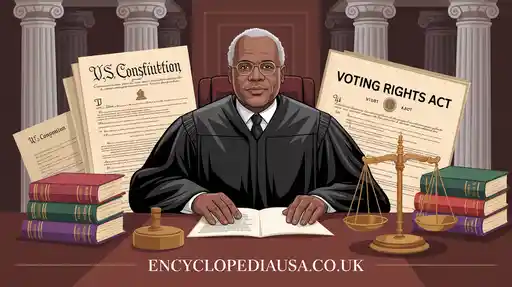
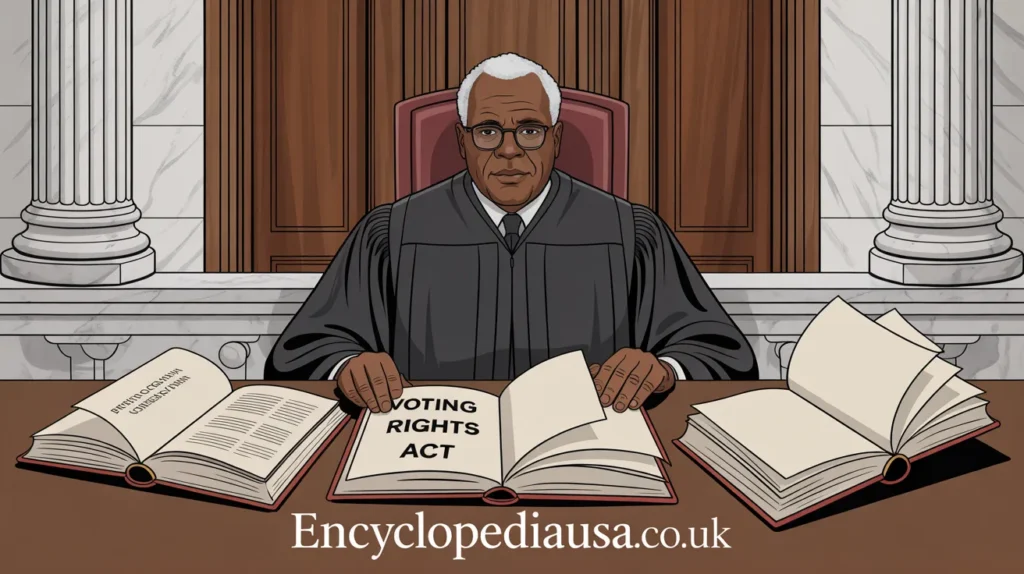
Supreme Court Justice Clarence Thomas holds one of the most controversial positions on the Voting Rights Act in modern American jurisprudence. His legal philosophy and judicial opinions on this landmark civil rights legislation have sparked intense debate, shaped significant court decisions, and potentially altered the landscape of voting rights protections that millions of Americans rely upon.
Understanding Clarence Thomas Voting Rights Act perspectives is essential for anyone concerned about democracy, civil rights, and the future of electoral access in America. His consistent opposition to key provisions of the Voting Rights Act represents a fundamental challenge to how the federal government protects minority voting rights. Whether you agree or disagree with his positions, his influence on the Supreme Court makes his views critically important.
This comprehensive analysis examines Justice Thomas’s voting record, written opinions, and legal reasoning regarding the Voting Rights Act. You’ll discover the constitutional arguments he presents, the criticism he faces, and the real-world implications of his judicial philosophy. From Shelby County to Brnovich, his fingerprints appear on decisions that fundamentally reshape voting rights enforcement. Understanding these positions helps you comprehend ongoing battles over ballot access, redistricting, and election laws across America.
Understanding the Voting Rights Act Background
Before examining Clarence Thomas Voting Rights Act positions, you need to understand what this legislation accomplished and why it matters so profoundly to American democracy.
The Historic 1965 Legislation
The Voting Rights Act of 1965 stands as one of the most significant civil rights achievements in American history. Congress passed this landmark legislation during the height of the civil rights movement. President Lyndon Johnson signed it into law amid national outrage over violent suppression of Black voters in the South.
The Act targeted discriminatory practices that prevented African Americans from exercising their constitutional right to vote. Literacy tests, poll taxes, and other barriers had systematically disenfranchised millions. The legislation provided federal oversight and enforcement mechanisms to dismantle these obstacles.
Section 5 became the Act’s most powerful provision. It required certain jurisdictions with histories of discrimination to obtain federal approval before changing voting laws. This preclearance requirement prevented discriminatory changes before they could harm voters.
Key Provisions and Protections
The Voting Rights Act contains several critical sections that protect electoral participation. Section 2 prohibits voting practices that discriminate based on race. This provision allows legal challenges to discriminatory election laws nationwide.
Section 5’s preclearance formula identified covered jurisdictions using specific criteria. These areas needed Department of Justice approval for any voting changes. The formula targeted regions with the worst histories of voter suppression and discrimination.
The Act also authorized federal examiners to register voters in resistant areas. It eliminated literacy tests and provided bilingual election materials in certain jurisdictions. These comprehensive protections transformed American democracy by ensuring meaningful access to the ballot.
Supreme Court’s Role in Enforcement
The Supreme Court interprets and applies the Voting Rights Act through various cases challenging its constitutionality and scope. These decisions shape how effectively the Act protects voting rights in practice.
Early Supreme Court decisions largely upheld the Act’s provisions. The Court recognized Congress’s authority to enforce the Fifteenth Amendment guaranteeing voting rights regardless of race. Justices acknowledged the historical necessity of strong federal intervention.
However, the Court’s composition and philosophy changed over decades. More conservative justices questioned whether extensive federal oversight remained constitutionally justified. This shift set the stage for landmark decisions that weakened voting rights protections significantly.
Clarence Thomas’s Judicial Philosophy
To understand Clarence Thomas Voting Rights Act positions, you must first grasp his broader constitutional interpretation approach. His judicial philosophy shapes every opinion he writes and vote he casts.
Originalism and Textualism Approach
Justice Thomas adheres strictly to originalism, interpreting the Constitution according to its original public meaning when ratified. He believes judges should apply the text as understood by those who wrote and approved it. Modern circumstances shouldn’t alter constitutional meaning in his view.
This approach leads Thomas to skepticism about expansive federal power. He questions government authority not explicitly granted by the Constitution’s text. His originalism often produces outcomes that limit federal intervention in state affairs.
Regarding voting rights, Thomas applies these principles rigorously. He examines what enforcement powers the Reconstruction Amendments originally conveyed to Congress. His narrow interpretation often conflicts with broader civil rights protections that developed over time.
Views on Federal Power and States’ Rights
Thomas champions state sovereignty and limited federal government. He believes the Constitution reserves most governance powers to states. Federal intervention should occur only when clearly authorized and absolutely necessary.
This federalism philosophy directly impacts his Voting Rights Act positions. Thomas views preclearance requirements as excessive federal intrusion into state election administration. He argues states possess inherent authority to manage their electoral processes without federal supervision.
His dissents and opinions consistently emphasize state prerogatives over federal civil rights enforcement. Thomas frames voting rights questions as federalism issues rather than primarily civil rights concerns. This framing produces very different conclusions than civil rights-focused analysis.
Constitutional Interpretation Methodology
Thomas often writes separately from other justices, even conservative colleagues. His opinions dig deep into historical records, founding-era documents, and original constitutional debates. He builds meticulous arguments from historical evidence.
However, critics argue his historical interpretations are selective and sometimes disputed by scholars. The founding era included contradictions, evolving views, and compromises that resist simple interpretation. Thomas’s certainty about original meaning sometimes glosses over historical complexity.
His methodology produces remarkably consistent results across different legal areas. Thomas rarely deviates from positions once established. This consistency provides predictability but also inflexibility when circumstances or evidence might warrant reconsideration.
Major Voting Rights Cases and Thomas’s Positions
Examining specific cases reveals how Clarence Thomas Voting Rights Act perspectives translate into concrete judicial outcomes that affect millions of Americans.
Shelby County v. Holder Decision
The 2013 Shelby County v. Holder decision fundamentally changed voting rights enforcement. The Court struck down the Voting Rights Act’s preclearance formula as unconstitutional. Chief Justice Roberts wrote the majority opinion that Thomas joined enthusiastically.
The decision held that the coverage formula used outdated data from the 1960s and 1970s. The majority argued that conditions had changed sufficiently to make the formula unconstitutional. States could no longer be subjected to preclearance based on decades-old discrimination evidence.
Justice Thomas wrote a concurring opinion arguing the entire preclearance system was unconstitutional, going further than the majority. He contended that Section 5 itself violated constitutional principles of state sovereignty. His position would have eliminated preclearance entirely, not just the coverage formula.
The practical impact proved devastating for voting rights protections. States previously requiring preclearance immediately implemented restrictive voting laws. Voter ID requirements, polling place closures, and registration restrictions proliferated. Civil rights advocates viewed Shelby County as gutting the Voting Rights Act’s most effective enforcement mechanism.
Northwest Austin Utility District Case
Before Shelby County, the 2009 Northwest Austin case foreshadowed challenges to the Voting Rights Act. A Texas utility district sought to escape preclearance requirements. The case questioned whether the Act’s coverage formula remained constitutionally valid.
The Court avoided the constitutional question by ruling narrowly on statutory grounds. However, the opinion expressed serious concerns about the preclearance regime’s continued constitutionality. This signaled that a constitutional challenge would likely succeed eventually.
Justice Thomas again went further in a separate opinion. He argued that the preclearance provision violated the Constitution and should be struck down immediately. His willingness to reach constitutional issues other justices avoided demonstrated his commitment to eliminating this voting rights protection.
This case revealed Thomas’s persistent opposition to preclearance regardless of Congressional reauthorization or updated findings. His position suggested no amount of evidence or Congressional action could justify continued federal oversight in his constitutional framework.
Brnovich v. Democratic National Committee
The 2021 Brnovich decision addressed Section 2 of the Voting Rights Act, which prohibits discriminatory voting practices. Arizona implemented laws restricting ballot collection and invalidating out-of-precinct ballots. Civil rights groups challenged these restrictions as discriminatory.
The Supreme Court upheld Arizona’s laws and established new standards making Section 2 challenges more difficult. The majority opinion created factors weighing against finding discrimination. These factors favor states defending restrictive voting laws.
Justice Thomas joined the majority but didn’t write separately in this case. However, his past statements and votes indicated strong support for limiting Section 2’s reach. The decision reflected his broader skepticism toward federal voting rights enforcement.
Brnovich made proving vote denial or dilution significantly harder. States gained more latitude to implement restrictions that disproportionately burden minority voters. Civil rights advocates saw this as further weakening the Voting Rights Act’s remaining protections after Shelby County eliminated preclearance.
Thomas’s Written Opinions and Reasoning
Examining Clarence Thomas Voting Rights Act opinions reveals the constitutional arguments and historical interpretations supporting his positions. His reasoning deserves serious consideration regardless of whether you find it persuasive.
Constitutional Arguments Presented
Thomas argues that Section 5’s preclearance requirement exceeds Congress’s enforcement powers under the Fifteenth Amendment. He contends the Constitution allows Congress to remedy constitutional violations but not prevent hypothetical future discrimination.
He views preclearance as impermissibly treating states unequally. The Constitution requires equal state sovereignty in his interpretation. Subjecting some states to federal oversight while others operate freely violates this principle fundamentally.
Thomas also questions whether racial disparities in voting necessarily indicate discrimination. He argues that neutral laws producing disparate impacts don’t automatically violate the Constitution. Intent to discriminate must be proven, not merely inferred from statistical differences.
These arguments reflect broader conservative legal movement positions. They prioritize state autonomy, require clear constitutional text authorization for federal action, and distinguish between disparate impact and intentional discrimination. Understanding these principles helps comprehend his voting rights positions.
Historical Analysis in Opinions
Justice Thomas extensively cites historical sources in his opinions. He examines Reconstruction era debates about the Fifteenth Amendment’s meaning and scope. He argues that the Amendment authorized only narrow federal intervention to prevent explicit race-based voting denials.
His historical analysis suggests that preclearance and disparate impact theories extend far beyond what Reconstruction Congress intended. Thomas believes modern voting rights enforcement has grown untethered from constitutional authorization.
However, critics note that Reconstruction era itself involved extensive federal intervention in Southern states. Military occupation, congressional reconstruction, and aggressive federal enforcement characterized the period. Some historians argue this context supports rather than undermines robust voting rights protections.
Thomas’s historical interpretations also face criticism for overlooking how constitutional understanding evolved through subsequent amendments, legislation, and Supreme Court precedent. Constitutional meaning develops over time through interpretation and application, not just original ratification.
Responses to Dissenting Opinions
Liberal justices have written powerful dissents challenging Thomas’s voting rights positions. Justice Ginsburg’s Shelby County dissent famously compared eliminating preclearance to “throwing away your umbrella in a rainstorm because you are not getting wet.”
Dissenting opinions emphasize ongoing discrimination in voting. They cite extensive Congressional findings documenting continued problems when the Voting Rights Act was reauthorized. They argue that preclearance remains necessary to prevent backsliding.
Dissenters also challenge the majority’s federalism arguments. They contend that the Fifteenth Amendment specifically authorizes Congress to override state sovereignty to protect voting rights. This represents an intentional constitutional choice to prioritize voting rights over state autonomy.
Thomas rarely directly responds to these dissenting arguments in his opinions. His separate writings focus on building his own constitutional case rather than engaging opposing viewpoints extensively. This approach reflects confidence in his interpretive methodology but leaves key counterarguments unaddressed.
Impact on Voting Rights Protections
The practical consequences of Clarence Thomas Voting Rights Act positions extend far beyond abstract constitutional theory. Real people experience real effects on their ability to participate in democracy.
State Voting Law Changes After Shelby
Within hours of the Shelby County decision, states began implementing voting restrictions previously blocked by preclearance. Texas announced a strict voter ID law would take immediate effect. North Carolina passed comprehensive restrictions on early voting, same-day registration, and student IDs.
Many previously covered jurisdictions closed polling places, particularly in minority communities. Voters faced longer lines, greater travel distances, and increased barriers to casting ballots. These changes disproportionately affected elderly, poor, and minority voters.
Voter purges accelerated as states removed registered voters from rolls using questionable criteria. Registration restrictions tightened. The cumulative effect created obstacles that echoed pre-Voting Rights Act suppression tactics, though generally less blatant.
Studies documented that these changes reduced turnout among minority voters. The protections that preclearance provided against discriminatory changes disappeared overnight. The hypothetical harms that Thomas considered insufficient to justify preclearance became documented reality.
Minority Voter Participation Trends
Research examining voter participation before and after Shelby County reveals troubling patterns. Minority turnout declined in some previously covered jurisdictions following restrictive law implementations. The gaps between white and minority participation widened.
However, interpreting these trends requires acknowledging multiple factors. Election competitiveness, candidate appeal, mobilization efforts, and economic conditions all affect turnout. Isolating voting law impacts from other variables proves methodologically challenging.
Nonetheless, the weight of evidence suggests that Shelby County and subsequent restrictions harmed minority political participation. Communities that relied on preclearance protections experienced measurable setbacks in electoral access and influence.
Defenders of restrictions argue that overall turnout sometimes increased despite new requirements. They contend this proves the laws aren’t discriminatory. Critics respond that turnout might have increased more without restrictions and that rights shouldn’t depend on overcoming obstacles through extraordinary effort.
Redistricting and Gerrymandering Implications
Thomas’s voting rights positions also affect redistricting and gerrymandering cases. His skepticism toward identifying racial discrimination influences how courts evaluate district maps that dilute minority voting power.
Without preclearance, states can implement gerrymandered maps that pack or crack minority communities without federal approval. Challenges must occur after implementation through lengthy litigation. By the time courts resolve disputes, entire election cycles may pass under discriminatory maps.
Section 2 challenges to discriminatory redistricting face higher hurdles after Brnovich and other decisions Thomas supported. Proving vote dilution requires meeting strict standards that favor state map-drawing over minority representation concerns.
The cumulative effect diminishes minority political power and representation. Communities that gained seats through Voting Rights Act enforcement find their influence eroded. This undermines the democratic principle of equal political participation.
Criticism and Support for Thomas’s Positions
Clarence Thomas Voting Rights Act views generate passionate responses from supporters and critics. Understanding both perspectives provides balanced insight into these contentious issues.
Civil Rights Groups’ Responses
Civil rights organizations uniformly oppose Thomas’s voting rights positions. The NAACP, ACLU, and similar groups view his opinions as fundamentally threatening to minority political participation. They argue his constitutional interpretations ignore ongoing discrimination realities.
These organizations emphasize that voting rights remain under constant attack. They document countless instances of discriminatory practices that preclearance prevented. They contend that eliminating these protections invited the voter suppression that immediately followed.
Critics also note the historical irony of an African American justice undermining protections that enabled his own generation’s political participation. They argue that Thomas benefits from civil rights advances while working to dismantle the legal frameworks that secured them.
However, these critiques sometimes veer into personal attacks rather than engaging his legal arguments substantively. The most effective criticisms address his constitutional reasoning and historical interpretations directly rather than questioning his motivations or identity.
Conservative Legal Scholars’ Views
Conservative legal scholars generally support Thomas’s voting rights positions. They praise his commitment to originalism and constitutional limits on federal power. They argue that emotional appeals shouldn’t override sound constitutional interpretation.
These scholars contend that voting rights can be protected through means other than preclearance. They point to Section 2 challenges, Department of Justice enforcement, and state constitutional protections. Federal micromanagement of state elections isn’t necessary in their view.
They also emphasize that extraordinary Reconstruction-era measures shouldn’t become permanent features of American federalism. The conditions justifying aggressive federal intervention have changed sufficiently to warrant restoring normal state-federal relationships.
Some conservative scholars acknowledge tension between voting rights protection and federalism principles. They seek approaches balancing these values rather than categorically prioritizing state sovereignty. These nuanced positions differ somewhat from Thomas’s more absolute stance.
Academic and Legal Community Analysis
Legal academics across the ideological spectrum analyze Thomas’s voting rights jurisprudence extensively. His opinions generate significant scholarly attention and debate. This academic engagement reflects the importance of these issues.
Liberal scholars generally criticize his historical analysis as selective and his constitutional interpretation as overly narrow. They argue that the Fifteenth Amendment’s enforcement clause grants Congress broad authority to protect voting rights against state interference.
They also challenge his view that racial progress makes voting rights protections unnecessary. They document ongoing discrimination and argue that success in preventing discrimination doesn’t prove protections are no longer needed. Rather, it demonstrates their effectiveness.
Conservative academics defend his methodology while sometimes disagreeing with specific applications. They appreciate his willingness to question precedent and established practices based on constitutional text and original meaning. They view this intellectual courage as admirable even when reaching controversial conclusions.
Comparison With Other Justices
Examining how Clarence Thomas Voting Rights Act positions compare with other justices illuminates the Court’s ideological divisions and his unique perspective even among conservatives.
Conservative Colleagues’ Approaches
Chief Justice Roberts authored the Shelby County majority opinion that Thomas joined. However, Roberts’s reasoning differed somewhat from Thomas’s more sweeping constitutional objections. Roberts focused on the outdated coverage formula rather than declaring all preclearance unconstitutional.
Justice Alito similarly votes with Thomas on voting rights cases but often writes or joins opinions stopping short of Thomas’s most expansive positions. These conservative colleagues reach similar outcomes through somewhat more incremental reasoning.
Justice Gorsuch and Justice Kavanaugh continue this pattern of general agreement with narrower reasoning. They share Thomas’s skepticism about expansive voting rights enforcement but sometimes prefer leaving certain constitutional questions undecided.
Thomas stands out even among conservatives for his willingness to embrace the broadest possible rulings against voting rights protections. His separate concurrences and dissents often urge going further than the majority, even when conservatives control the Court.
Liberal Justices’ Contrasting Views
Liberal justices offer starkly different voting rights perspectives. Justice Sotomayor, Justice Kagan, and Justice Ketanji Brown Jackson (replacing Justice Breyer) consistently vote to uphold and strengthen voting rights protections.
Their opinions emphasize ongoing discrimination, congressional findings, and the Fifteenth Amendment’s remedial purpose. They interpret constitutional enforcement powers broadly and defer to Congressional judgments about necessary protections.
Liberal justices also stress the real-world consequences of weakening voting rights enforcement. Their opinions cite specific instances of discrimination and voter suppression that resulted from eliminating protections. They prioritize practical outcomes over abstract constitutional theories.
The philosophical gulf between Thomas and liberal colleagues reflects fundamental disagreements about constitutional interpretation, federal-state relationships, and how to evaluate racial progress. These differences make compromise or common ground virtually impossible on voting rights issues.
Historical Supreme Court Positions
Comparing current positions with historical Supreme Court voting rights jurisprudence reveals significant shifts. The Warren and Burger Courts largely upheld strong voting rights enforcement despite federalism concerns.
Earlier conservative justices like Justice Harlan dissented from some Voting Rights Act decisions but generally accepted Congressional authority once the Act was upheld. The current conservative majority’s skepticism exceeds historical conservative positions significantly.
This shift reflects broader changes in conservative legal movement priorities and strategies. Modern originalism and textualism provide frameworks for challenging longstanding precedents that earlier conservatives accepted. Thomas exemplifies this more aggressive approach to reconsidering settled law.
Political and Social Context
Understanding Clarence Thomas Voting Rights Act positions requires examining the broader political and social environment surrounding these legal battles. Constitutional cases don’t occur in vacuums.
Contemporary Voting Rights Debates
Voting rights have become intensely partisan political issues. Republican-controlled legislatures generally implement restrictions they claim prevent fraud and ensure election integrity. Democratic officials and civil rights groups challenge these laws as discriminatory voter suppression.
This polarization affects how people interpret Supreme Court decisions. Republicans applaud rulings limiting federal oversight as restoring proper federalism. Democrats condemn identical decisions as enabling discrimination and undermining democracy.
The heated political context makes dispassionate legal analysis difficult. Every voting rights case becomes ammunition in broader partisan battles over electoral control and political power. Constitutional principles become entangled with political strategies.
Thomas’s positions align with Republican policy preferences regarding voting laws. This creates suspicions about whether political ideology drives his constitutional interpretation. However, his consistent methodology across different legal areas suggests principled rather than purely partisan reasoning.
Partisan Implications of Decisions
Voting restrictions disproportionately affect constituencies that lean Democratic. Minority voters, young voters, and urban populations face greater obstacles under many challenged laws. These demographic groups tend to support Democratic candidates.
Republican electoral success sometimes correlates with lower minority turnout. This creates obvious incentives for Republican officials to support restrictions. Democrats similarly benefit from high minority participation and oppose restrictions for both principled and strategic reasons.
Supreme Court decisions enabling restrictions therefore carry partisan consequences regardless of justices’ intentions. Weakening voting rights enforcement advantages Republicans electorally in many jurisdictions. This reality fuels accusations of partisan judging.
Thomas maintains that constitutional interpretation should ignore political consequences. Judges must apply the law as written regardless of who benefits or suffers politically. However, critics question whether such complete separation is truly possible or whether it masks ideological preferences.
Public Opinion on Voting Access
Public opinion polls show strong support for making voting easier rather than harder. Majorities favor expanded early voting, mail voting options, and accessible registration. Voter ID requirements receive mixed support depending on question wording and specifics.
Significantly, support for voting access crosses partisan lines when questions avoid politically charged framing. Americans generally believe voting should be convenient and accessible to all eligible citizens. They oppose discrimination while also supporting election security.
This public opinion context suggests that Supreme Court decisions restricting voting rights protections diverge from popular preferences. Democratic values emphasize broad participation and accessible elections. The Court’s conservative majority pursues directions that many Americans view skeptically.
However, public opinion doesn’t determine constitutional interpretation in the judicial philosophy Thomas embraces. Originalism looks to founding era understanding rather than contemporary preferences. Popularity doesn’t make laws constitutional or unpopular laws invalid in this framework.
Future Implications and Ongoing Cases
Clarence Thomas Voting Rights Act positions will continue shaping American democracy for years to come. Understanding potential future developments helps you anticipate ongoing battles over electoral access.
Pending Voting Rights Litigation
Numerous voting rights cases currently work through lower courts. Challenges to redistricting plans, voter ID laws, registration restrictions, and polling place changes all potentially reach the Supreme Court. Thomas’s votes will likely prove decisive in many decisions.
Section 2 challenges face uncertain futures after Brnovich established more restrictive standards. Lower courts struggle to apply these new rules consistently. The Supreme Court may need to clarify how far states can go in restricting voting before violating Section 2.
Independent state legislature theory cases could further limit federal oversight of state election laws. If the Court embraces this theory broadly, state legislatures might gain nearly unlimited authority over election rules. Thomas’s support for aggressive state sovereignty suggests he would endorse such outcomes.
Potential Legislative Responses
Congress could respond to Supreme Court decisions by updating the Voting Rights Act. The John Lewis Voting Rights Advancement Act proposes new preclearance coverage formulas addressing the Shelby County decision. It aims to restore federal oversight using current data.
However, legislative action faces significant political obstacles. Senate filibuster rules require 60 votes for most legislation. Voting rights bills cannot attract sufficient bipartisan support in the current polarized environment. This legislative gridlock leaves judicial decisions as the final word.
Some advocates propose broader democracy reforms including statehood for District of Columbia and Puerto Rico, eliminating the filibuster, or expanding the Supreme Court. These dramatic changes face even higher political barriers than simple Voting Rights Act updates.
The practical reality is that Clarence Thomas Voting Rights Act positions will likely govern for the foreseeable future. Legislative correction appears unlikely absent major political realignment or crisis forcing action.
Long-Term Democratic Implications
The cumulative effect of weakened voting rights enforcement could fundamentally alter American democracy. If minority participation declines and representation diminishes, entire communities lose political voice and power.
Decreased faith in electoral fairness and accessibility might reduce overall civic engagement. When people believe the system is rigged or their votes don’t matter, democratic participation suffers. This creates self-fulfilling cycles of declining turnout and legitimacy.
However, activism and litigation continue despite unfavorable Supreme Court rulings. Civil rights organizations adapt strategies to new legal realities. State constitutional protections sometimes provide remedies federal courts deny. The battle for voting rights continues through multiple venues.
The long-term trajectory depends partly on future Supreme Court appointments. Thomas is among the older justices, though he shows no signs of retiring soon. Future appointments could either entrench or reverse current voting rights jurisprudence depending on presidential and Senate election outcomes.
Conclusion
Clarence Thomas Voting Rights Act positions represent one of the most consequential and controversial aspects of his Supreme Court tenure. His consistent opposition to federal voting rights enforcement fundamentally challenges protections that civil rights advocates consider essential to democracy. Whether viewed as principled constitutional interpretation or dangerous judicial activism, his influence reshapes American electoral law profoundly.
Understanding Thomas’s reasoning requires grappling with competing constitutional values. Federalism, state sovereignty, and limited government clash with civil rights protection, equal participation, and remedying historical discrimination. How you balance these principles largely determines whether you find his positions persuasive or alarming.
The practical consequences of his votes affect millions of Americans’ ability to participate meaningfully in democracy. Voting restrictions proliferated after Shelby County eliminated preclearance. Minority communities face renewed obstacles to registration and voting. These real-world impacts extend far beyond abstract legal theory.
As voting rights battles continue in courts, legislatures, and public discourse, Clarence Thomas Voting Rights Act jurisprudence will remain central to outcomes. His votes shape not just individual cases but the entire framework for evaluating discrimination claims and federal enforcement authority. Understanding his positions is essential for anyone engaged with American democracy’s future.
The fundamental question remains whether robust federal voting rights enforcement remains necessary or whether changed conditions justify restoration of traditional state autonomy. Your answer to this question likely determines whether you view Justice Thomas as a constitutional guardian or a threat to civil rights progress. What role do you believe federal oversight should play in protecting voting rights, and how should courts balance competing constitutional values in this critical area?
Frequently Asked Questions
What is Justice Clarence Thomas’s position on the Voting Rights Act?
Justice Clarence Thomas consistently opposes the Voting Rights Act’s federal enforcement mechanisms, particularly the preclearance requirement. He argues that Section 5 preclearance exceeds Congress’s constitutional authority and violates state sovereignty. Thomas contends that the Fifteenth Amendment allows Congress to remedy proven discrimination but not prevent hypothetical future violations through federal oversight of state election laws.
How did Clarence Thomas vote in Shelby County v. Holder?
Thomas joined the majority in Shelby County v. Holder, which struck down the Voting Rights Act’s coverage formula. He also wrote a separate concurring opinion arguing that the entire Section 5 preclearance system was unconstitutional. His position went further than the majority, which invalidated only the coverage formula while leaving the preclearance mechanism itself theoretically intact.
Why does Clarence Thomas oppose voting rights protections?
Thomas doesn’t frame his position as opposing voting rights but rather as enforcing constitutional limits on federal power. He argues that federalism principles require respecting state sovereignty over election administration. Thomas contends that modern conditions don’t justify extraordinary federal intervention that was necessary during Reconstruction. He believes states should manage elections without federal preclearance requirements.
How have Thomas’s voting rights positions affected minority voters?
Thomas’s votes in cases weakening the Voting Rights Act contributed to increased voting restrictions in many states. Research documents that minority voter participation declined in some jurisdictions following the elimination of preclearance and implementation of restrictive laws. His positions make challenging discriminatory voting practices significantly more difficult through legal action.
What is the constitutional basis for Thomas’s voting rights positions?
Thomas bases his positions on originalist interpretation of the Fifteenth Amendment and constitutional federalism principles. He argues that the Amendment’s enforcement clause grants Congress narrow authority to remedy specific constitutional violations, not broad power to prevent hypothetical discrimination. He also emphasizes that the Constitution requires equal state sovereignty, which preclearance violates in his view.
Do other conservative justices agree with Clarence Thomas on voting rights?
Conservative justices generally vote with Thomas on voting rights cases but sometimes use narrower reasoning. Chief Justice Roberts, Justice Alito, and newer conservative appointees reach similar outcomes while occasionally stopping short of Thomas’s broadest constitutional arguments. Thomas often writes separately urging more sweeping rulings than his conservative colleagues embrace.
How can Congress respond to Supreme Court voting rights decisions?
Congress could update the Voting Rights Act with new preclearance coverage formulas based on current discrimination evidence. The John Lewis Voting Rights Advancement Act proposes such updates. However, Senate filibuster rules make passing voting rights legislation extremely difficult without bipartisan support that currently doesn’t exist for these measures.
What voting rights cases might the Supreme Court hear next?
The Supreme Court may hear cases involving redistricting challenges, voter ID requirements, registration restrictions, and independent state legislature theory. Many voting rights cases currently work through lower courts and could eventually reach the Supreme Court. Thomas’s positions will likely influence outcomes in these future cases significantly.
Has Clarence Thomas ever supported voting rights protections?
Thomas consistently applies his constitutional interpretation methodology that generally disfavors federal voting rights enforcement. His voting record shows no significant instances of supporting Voting Rights Act provisions against constitutional challenges. His judicial philosophy produces remarkably consistent opposition to federal oversight of state election laws.
What do civil rights organizations say about Thomas’s voting rights positions?
Civil rights organizations including the NAACP and ACLU strongly oppose Thomas’s voting rights jurisprudence. They argue his positions ignore ongoing discrimination and enable voter suppression. These groups contend that his constitutional interpretations undermine protections essential for minority political participation and equal access to democracy.
Author Bio
A legal analyst and constitutional law researcher specializing in Supreme Court jurisprudence and civil rights litigation. With extensive experience analyzing judicial opinions and their societal impacts, the author provides balanced examinations of complex constitutional questions. Dedicated to making legal issues accessible while maintaining analytical rigor and acknowledging multiple perspectives on controversial topics.