


How Big Is a Soccer Field? Complete Dimensions, Sizes & Measurements Guide (2026)
Introduction
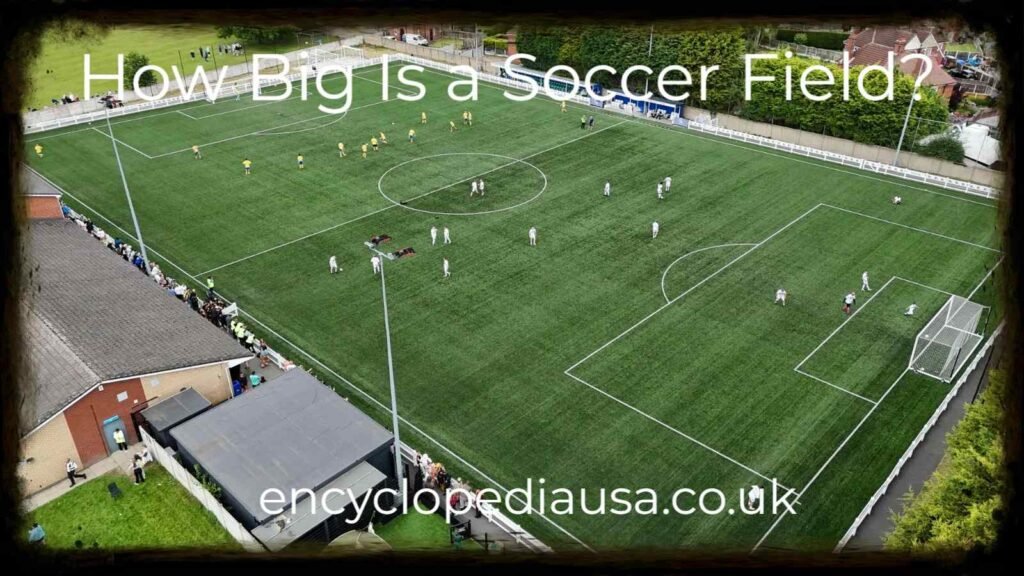
If you’ve ever wondered how big is a soccer field, the answer depends on the level and type of match being played. Unlike some sports, soccer does not have one fixed field size. Professional, international, youth, high school, and recreational fields can all have different dimensions while still meeting the required rules.
In this complete guide, we’ll explain soccer field dimensions, length, width, measurements, goal size, penalty areas, and markings in simple terms. You’ll also learn how professional and international soccer fields compare, how large a field is in acres and square feet, and what size fields are commonly used for youth soccer in 2026.
Standard Soccer Field Dimensions
Let’s start with the basics. According to FIFA, the international governing body of soccer, a regulation field must fall within specific measurement ranges.
For international matches, the length must be between 100 and 110 meters. That’s roughly 110 to 120 yards if you prefer imperial measurements. The width needs to be between 64 and 75 meters, which translates to about 70 to 80 yards.
These aren’t small spaces we’re talking about. A full-sized soccer field covers between 6,400 and 8,250 square meters. In more familiar terms, that’s about 1.6 to 2 acres of playing surface.
The most common dimensions you’ll see are 105 meters long by 68 meters wide. This size has become something of an unofficial standard. Many professional stadiums around the world use these exact measurements.
Why the Range Exists
You might wonder why FIFA allows such variation. The flexibility serves several practical purposes.
Different climates and regions have different constraints. A stadium in a dense urban area might not have room for the maximum dimensions. Weather conditions in certain locations might favor slightly smaller or larger fields.
The range also allows for strategic preferences. Some teams prefer wider fields to spread the play. Others like narrower dimensions that force more central action.
Youth Soccer Field Sizes
When it comes to youth soccer, the dimensions change dramatically. You can’t expect young children to play on full-sized professional fields.
For players under six years old, fields typically measure about 20 by 15 yards. These tiny pitches help kids develop basic skills without getting overwhelmed by space.
As children grow, so do their fields. Under-8 players usually compete on fields around 30 by 20 yards. Under-10 matches happen on roughly 50 by 30-yard fields.
By the time players reach under-12 level, they’re playing on fields closer to 70 by 50 yards. This gradual progression makes perfect sense when you think about it.
The Philosophy Behind Smaller Fields
There’s real science behind these scaled-down dimensions. Smaller fields mean more touches on the ball for each player. Kids stay engaged instead of spending half the match jogging across vast empty spaces.
Youth coaches emphasize skill development over physical endurance. A properly sized field for young players promotes better learning. They get more chances to dribble, pass, and shoot.
I’ve watched youth games on oversized fields, and the difference is striking. Kids spend too much energy running and not enough time actually playing soccer.
Professional League Variations
Major professional leagues each have their own approach to field dimensions. These variations create interesting tactical differences.
The English Premier League requires fields to be 105 meters long and 68 meters wide. There’s no flexibility here. Every EPL stadium must meet this exact specification.
Spain’s La Liga takes a different approach. Fields must be between 100 and 105 meters long and 64 to 68 meters wide. This gives clubs some room to choose.
Germany’s Bundesliga mandates 105 by 68 meters, matching the Premier League standard. Italy’s Serie A allows the same range as La Liga.
Source: mightygrass.com
MLS and American Soccer
Major League Soccer in the United States shows even more variation. MLS fields must be between 110 and 120 yards long and 70 to 75 yards wide.
You’ll notice MLS uses yards instead of meters. This reflects American measurement preferences. When converted to meters, MLS fields roughly match international standards.
Some MLS stadiums share space with American football teams. This creates unique constraints. The field needs to fit within an American football configuration.
The Penalty Area and Goal Box
Understanding how big is a soccer field requires looking at the markings within it. The penalty area is one of the most important zones.
The penalty area extends 16.5 meters from each goal post. It reaches 16.5 meters into the field as well. This creates a rectangular box where goalkeepers can use their hands.
Inside the penalty area sits the goal box, sometimes called the six-yard box. This smaller rectangle extends six yards from each post and six yards into the field.
These measurements stay constant regardless of the field’s overall size. A youth field and a World Cup pitch both use the same penalty area dimensions.
The Center Circle
At the heart of every soccer field is the center circle. This circle has a radius of 10 yards from the center spot.
During kickoff, all players except the kicker must stay outside this circle. It creates a fair starting point for each half and after goals.
The center line divides the field into two equal halves. Players must stay in their own half during kickoff until the ball moves.
Corner Areas and Technical Zones
Each corner of the field features a small arc with a one-yard radius. This is where corner kicks are taken from.
The corner flag must stand at least five feet tall. It marks the exact corner point and helps referees judge when balls go out of bounds.
Along the sidelines, you’ll find technical areas for coaches and substitutes. These zones extend one meter on each side of the team benches.
Technical areas typically stretch from the bench to one meter beyond the penalty area. Coaches must remain within this space during matches.
World Cup Field Standards
When the World Cup comes around, FIFA enforces strict standards. Tournament fields must be exactly 105 meters long and 68 meters wide.
There’s zero flexibility during the World Cup. Every stadium hosting matches must meet these precise dimensions. This ensures fairness across all venues.
The grass quality also faces rigorous standards. FIFA tests the surface for ball roll, bounce, and player traction. Temperature and moisture levels are carefully controlled.
Olympic Soccer Specifications
Olympic soccer follows similar rules to the World Cup. Fields must fall within FIFA’s international match standards.
Olympic venues use the 100 to 110 meter length range. Width stays between 64 and 75 meters. Most Olympic fields end up being 105 by 68 meters anyway.
The consistency helps players adapt quickly. They don’t need to adjust their spatial awareness between different tournament venues. Source: Turf Tank
How Field Size Affects Gameplay
The dimensions of a soccer field have real tactical implications. Coaches think carefully about field size when developing strategies.
Wider fields favor teams with fast wingers. Players can stretch the defense and create space on the flanks. Teams like Liverpool and Manchester City prefer maximum width.
Narrower fields compress the play into central areas. This benefits teams with strong midfield control. Possession-based teams sometimes prefer tighter spaces.
Home Field Advantage
Some clubs use field dimensions as a home advantage. They choose measurements that suit their playing style.
A team built around crossing and wing play might use a wider field. A team focused on quick passing through the middle might go narrower.
This strategic choice is perfectly legal within FIFA’s guidelines. It’s one of many subtle ways teams try to gain an edge.
Indoor Soccer and Futsal Differences
Indoor soccer operates on completely different dimensions. These fields are much smaller than outdoor pitches.
A typical indoor soccer field measures about 200 feet long by 85 feet wide. The playing surface is usually artificial turf or a specialized court material.
Futsal, the official small-sided version, uses courts between 38 and 42 meters long. Width ranges from 20 to 25 meters. These tight spaces create a fast-paced game.
Why Smaller Works Indoors
Indoor facilities have obvious space constraints. But the smaller dimensions also change the game fundamentally.
Players develop better close control in tight spaces. The ball moves faster with less distance to cover. Futsal has become a crucial training tool for developing technical skills.
Many of the world’s best players grew up playing futsal. The confined space forces quick thinking and precise ball handling.
Measuring and Maintaining Field Dimensions
Groundskeepers face the challenge of maintaining exact field measurements. This requires specialized equipment and regular attention.
Professional stadiums use laser measuring tools. These devices ensure perfect accuracy down to the centimeter. Lines get repainted weekly or even more frequently.
The grass itself needs constant care. Mowing patterns affect how the field looks on television. Height must stay within specified ranges for proper ball movement.
Drainage and Surface Quality
Modern fields include sophisticated drainage systems. Water can’t be allowed to pool on the playing surface. Underground pipes and graded surfaces move water away quickly.
The soil composition matters too. Fields need the right balance of firmness and give. Too hard and players risk injury. Too soft and the ball won’t roll properly.
Top stadiums spend millions maintaining their pitches. It’s not just about looks. Surface quality directly impacts player performance and safety.
Common Misconceptions About Field Size
Many people believe all professional soccer fields are identical. As you now know, that’s not true. The variation is built into the rules.
Another myth suggests bigger fields always favor better teams. Reality is more nuanced. Field size impacts different playing styles in various ways.
Some fans think field dimensions changed over the years. Actually, the current standards have remained relatively stable for decades. Minor adjustments happened, but the basic ranges stayed consistent.
American Football Field Comparison
People often compare soccer fields to American football fields. An American football field is 120 yards long including end zones and 53.3 yards wide.
This makes football fields significantly narrower than most soccer pitches. Soccer fields are also typically longer. The sports have very different spatial requirements.
When stadiums host both sports, the soccer field usually fits inside the football configuration. The width creates the biggest challenge in these dual-purpose venues.
Choosing the Right Field Size for Your Needs
If you’re involved in setting up a soccer field, several factors matter. Budget and available space are obvious considerations.
The age and skill level of players should guide your decision. Always scale appropriately for youth players. Using adult field dimensions for children hurts their development.
Local league regulations might dictate specific requirements. Check with your governing body before finalizing measurements. You don’t want to build a field that can’t host official matches.
Recreational vs Competitive
Recreational fields can be more flexible with dimensions. The focus is on fun and participation rather than strict regulation.
Competitive fields need to meet league standards. Teams expect consistency when they travel for matches. Wild variation in field size creates unfair conditions.
Consider long-term use when planning. A field built for youth players today might need expansion as those players grow. Building with future needs in mind saves money later.
Conclusion
So how big is a soccer field? As you’ve learned, the answer depends on the context. International matches use fields between 100 and 110 meters long and 64 to 75 meters wide. Professional leagues often standardize around 105 by 68 meters. Youth fields scale down dramatically based on age groups.
These dimensions aren’t arbitrary. They reflect decades of understanding about what makes soccer work as a sport. The size affects tactics, player development, and the overall flow of the game.
Whether you’re a player adapting to a new field, a parent watching your child’s game, or a fan analyzing professional matches, understanding field dimensions adds depth to your appreciation of soccer. The next time you watch a match, take a moment to consider how the field size influences what you’re seeing.
What’s your experience with different soccer field sizes? Have you noticed how dimensions change the way teams play?
FAQs
What is the exact size of a FIFA regulation soccer field? FIFA requires international match fields to be between 100 and 110 meters long and 64 to 75 meters wide. The most common size is 105 meters by 68 meters, though any dimension within the official range is acceptable for international competition.
Are all professional soccer fields the same size? No, professional soccer fields vary within FIFA’s guidelines. The English Premier League standardizes at 105 by 68 meters, while other leagues allow some variation. All must fall within the acceptable range for professional play.
How does a soccer field compare to an American football field? A soccer field is typically longer and much wider than an American football field. Football fields are 120 yards long by 53.3 yards wide, while soccer fields usually measure about 115 yards by 75 yards, making them significantly wider.
Why are youth soccer fields smaller than adult fields? Smaller fields help young players develop better skills. Kids get more touches on the ball and stay engaged throughout the match. As children grow and their abilities develop, field sizes gradually increase to match their physical capabilities.
Can a soccer field be too big or too small for official play? Yes, fields must stay within FIFA’s specified ranges. Anything shorter than 100 meters or narrower than 64 meters is too small for international matches. Fields longer than 110 meters or wider than 75 meters exceed the maximum allowed dimensions.
What happens if a soccer field doesn’t meet regulation size? Fields that don’t meet regulation standards can’t host official competitive matches at the appropriate level. Youth and recreational leagues may allow non-standard dimensions, but professional and international competitions require strict compliance with size requirements.
How do you measure a soccer field accurately? Professional groundskeepers use laser measuring devices for precision. They measure from goal line to goal line for length and from touchline to touchline for width. Regular checks ensure the field maintains its dimensions over time.
Do indoor soccer fields follow the same size requirements? No, indoor soccer and futsal use much smaller dimensions. Indoor fields are typically about 200 feet by 85 feet, while futsal courts range from 38 to 42 meters long and 20 to 25 meters wide.
Why do some teams prefer different field dimensions? Field size affects tactical approaches. Teams with fast wingers prefer wider fields for space on the flanks. Teams focused on possession and central play might choose narrower dimensions within the allowed range.
What’s the smallest field size allowed for adult soccer? For non-international adult matches, FIFA allows fields as small as 90 meters long and 45 meters wide. However, international matches require minimum dimensions of 100 meters by 64 meters.
also read encyclopediausa.co.uk