


PhD in Education vs EdD: Which Degree Actually Pays Off? in 2026
Introduction
You want to earn a doctorate in education, but you keep hitting the same wall. Should you choose a PhD in Education or an EdD? This single question stops thousands of aspiring scholars and school leaders every year, and honestly, it should. Picking the wrong path can cost you years and thousands of dollars in tuition you didn’t need to spend.
The good news is that the PhD in Education vs EdD decision is not as confusing as it looks once you break it down. One degree trains researchers. The other trains practitioners and leaders. Your career goals, not your love of learning, should drive the choice.
In this article, you will get a clear, side by side comparison of both degrees. You will see what each program actually teaches, how long each one takes, what they cost, and which careers each one unlocks. By the end, you will know exactly which doctorate fits your goals.
What Is a PhD in Education?
A PhD in Education, or Doctor of Philosophy in Education, is a research focused degree. It trains you to generate new knowledge in the field of education through original studies, data analysis, and academic publishing.
Most PhD programs prepare graduates for roles in academia. You will spend a large portion of your time on:
- Quantitative and qualitative research methods
- Statistical analysis and data modeling
- Writing and defending an original dissertation
- Publishing peer reviewed journal articles
- Teaching undergraduate or graduate courses as a teaching assistant
If you enjoy asking why something works the way it does, a PhD suits your mindset. You spend years testing theories rather than applying existing ones.
What Is an EdD?
An EdD, or Doctor of Education, is a practice focused degree. It trains current or aspiring leaders to solve real problems inside schools, districts, universities, and other organizations.
EdD programs center on applied research. Instead of building new theory, you learn to use existing research to fix practical challenges. Coursework often includes:
- Educational leadership and organizational change
- Policy analysis and implementation
- Applied research projects tied to your workplace
- Budgeting, staffing, and administrative strategy
- A capstone project instead of a traditional dissertation
Most EdD students already work full time in education while studying part time. The degree fits around a career rather than pausing it.
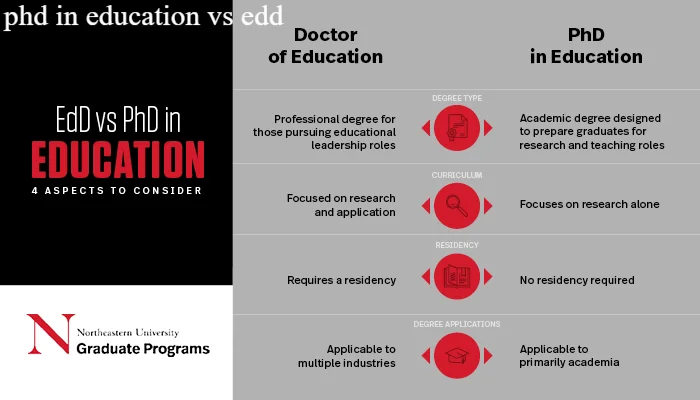
PhD in Education vs EdD: Quick Comparison Table
| Feature | PhD in Education | EdD |
|---|---|---|
| Primary focus | Original research and theory | Applied problem solving |
| Typical career path | Professor, researcher, policy analyst | Principal, superintendent, dean, administrator |
| Final project | Dissertation based on original research | Capstone tied to a real world problem |
| Average duration | 4 to 7 years | 3 to 4 years |
| Study format | Often full time and campus based | Often part time and online friendly |
| Best suited for | Aspiring academics and researchers | Working professionals and leaders |
| Funding availability | More assistantships and stipends | Fewer stipends, more self funded |
This table gives you the fast answer. The sections below explain the reasoning behind each row.
Career Outcomes: Where Each Degree Leads
PhD in Education Careers
A PhD opens doors mainly inside higher education and research institutions. Common roles include:
- University professor or lecturer
- Educational researcher at a think tank
- Policy analyst for a government agency
- Curriculum research director
- Data scientist focused on education outcomes
According to the U.S. Bureau of Labor Statistics, postsecondary teachers earned a median annual wage of around $84,380 as of 2023, though this varies widely by institution type and subject area.
EdD Careers
An EdD suits people who already work in schools or organizations and want to move into leadership. Common roles include:
- School principal or assistant principal
- District superintendent
- Dean of students or academic affairs
- Director of curriculum and instruction
- Nonprofit or corporate training leader
The National Center for Education Statistics reports that school district superintendents often hold a doctorate, and many pursue the EdD specifically because it aligns with administrative licensure requirements in several states.
Cost and Time: What You Are Really Signing Up For
Doctoral degrees demand serious investment, and the numbers differ by path.
PhD programs often take longer, sometimes stretching past six years, because the dissertation process involves years of original data collection and multiple rounds of committee review. On the upside, many PhD candidates receive funding through teaching or research assistantships, which can cover tuition and provide a modest stipend.
EdD programs typically wrap up faster, often within three to four years, since students already bring professional experience into their coursework and capstone project. Funding is less common, so most EdD students pay out of pocket or rely on employer tuition assistance.
I always tell people considering either path to ask their target programs directly about assistantship availability. That single detail can shift your total cost by tens of thousands of dollars.
soures; onlinegrad.pepperdine.edu
PhD vs EdD: Which One Fits Your Personality?
Ask yourself these questions before you apply.
Do you want to teach at the university level someday? Choose the PhD. Most tenure track faculty positions require it.
Do you already lead a team, school, or department and want to grow into a bigger role? Choose the EdD. It builds leadership skills you can apply immediately.
Do you love designing studies and analyzing data for its own sake? Choose the PhD. Research is the heart of the program.
Do you want to fix a specific problem at your current workplace? Choose the EdD. Capstone projects usually tackle real organizational issues.
Can you study full time for several years? If yes, a PhD becomes more realistic. If you need to keep working, the EdD fits better.
What Experts Say About the Decision
Dr. Carol Kasworm, a longtime scholar in adult and higher education, has noted that EdD programs have evolved significantly over the past two decades to emphasize applied scholarship rather than mimicking traditional PhD research models. This shift explains why more universities now separate the two degrees clearly instead of blending them together.
Many education deans also point out a growing trend: EdD enrollment has climbed steadily as more working professionals seek credentials that boost their careers without requiring a full academic research track. Meanwhile, PhD enrollment remains steady among students committed to long term academic careers.
Common Mistakes People Make When Choosing
Avoid these pitfalls before you commit to either degree.
- Choosing a PhD only because it sounds more prestigious, without wanting an academic career
- Choosing an EdD without checking if your target job actually requires it
- Ignoring funding differences and underestimating total cost
- Picking a program based on ranking alone instead of faculty fit and research focus
- Assuming both degrees are interchangeable for licensure or administrative roles
Every state and institution sets its own rules, so always confirm requirements with your target employer or state licensing board before enrolling.
Final Thoughts
The PhD in Education vs EdD decision really comes down to one question. Do you want to research education or lead within it? A PhD suits future scholars and professors who want to generate new knowledge. An EdD suits working professionals who want to apply research and lead organizations more effectively.
Take time to map out your five year career goals before you apply. Talk to graduates from both types of programs if you can. Their real experiences will tell you more than any brochure.
Which path feels closer to where you see yourself in five years? Share your thoughts or questions in the comments, and pass this guide along to anyone else stuck at the same crossroad.
Frequently Asked Questions
Is an EdD as respected as a PhD? Yes. Both are terminal doctoral degrees. An EdD carries strong respect in education leadership circles, while a PhD carries more weight in academic and research settings.
Can EdD graduates become professors? Yes, many do, especially in professional practice programs. However, tenure track research positions at major universities often prefer PhD holders.
Which degree takes less time to finish? The EdD usually finishes faster, often in three to four years, because it does not require the same depth of original research as a PhD dissertation.
Do I need a masters degree before starting either program? Most programs require a masters degree for admission, though some universities now offer combined bachelor to doctorate tracks.
Is the EdD cheaper than the PhD? Not always. PhD programs often offer more funding through assistantships, which can lower the actual out of pocket cost compared to a self funded EdD.
Can I switch from an EdD to a PhD later? It is possible but uncommon. You would typically need to reapply and may lose some credits, since the two programs have different core requirements.
Which degree is better for school administration jobs? The EdD generally aligns better with school administration and superintendent licensure requirements in most states.
Do employers care which doctorate you hold? It depends on the role. Academic positions usually prefer a PhD, while leadership and administrative roles usually value the EdD.
About the Author
Our education team includes writers and researchers who specialize in graduate school guidance and academic career planning. We break down complex degree decisions into clear, practical advice so students can choose the path that truly fits their goals.