
The Associative Property: A Simple Math Rule That Makes Everything Easier 2026
Introduction
Have you ever rearranged numbers in your head while doing mental math — and somehow made the problem way easier? That’s not a coincidence. That’s the associative property doing its job quietly in the background.
The associative property is one of the most fundamental rules in mathematics. It shows up in basic arithmetic, algebra, and even advanced math. Yet a lot of people either forget about it or never really understood it in the first place. If that’s you, don’t worry. By the end of this article, you’ll not only understand the associative property clearly — you’ll actually appreciate how useful it is.
In this article, we’ll cover what the associative property means, how it works for both addition and multiplication, what it does not apply to, common mistakes people make, and real-life examples that make it click. Let’s get into it.
What Is the Associative Property?
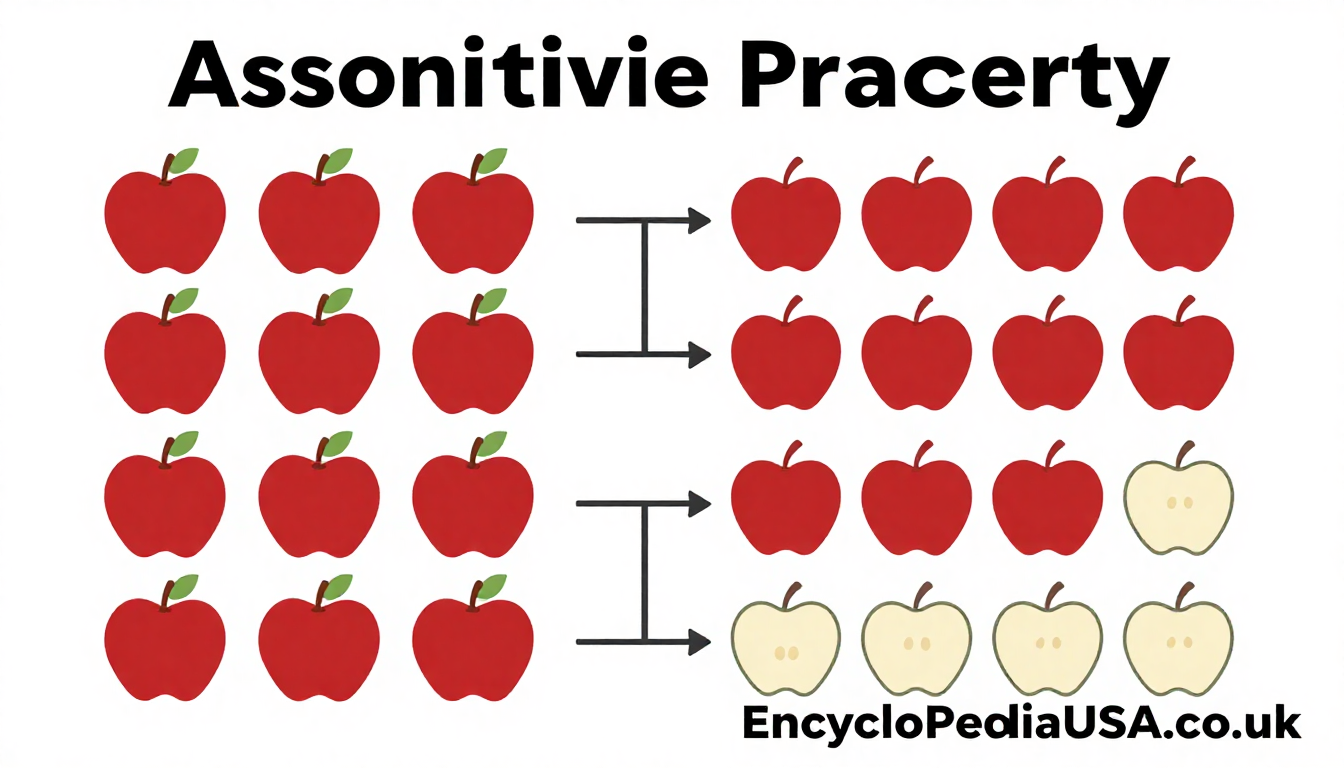
The associative property is a rule in mathematics that says the way you group numbers in an addition or multiplication problem does not change the result. It doesn’t matter which pair you calculate first. The final answer stays the same.
Here’s the formal definition broken down simply:
For addition: (a + b) + c = a + (b + c)
For multiplication: (a × b) × c = a × (b × c)
That’s it. The grouping changes, but the answer doesn’t. This is the core idea behind the associative property.
The word “associative” actually comes from the word “associate,” which means to connect or group together. So the associative property is really just about how numbers are associated or grouped — and the point is that it doesn’t matter.
Associative Property of Addition: Explained with Examples
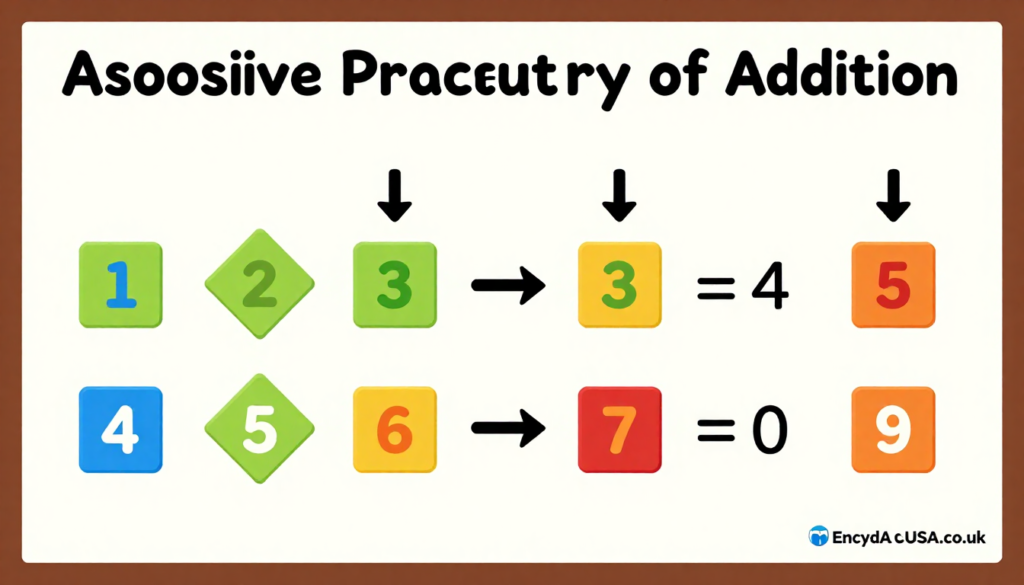
Let’s start with addition because it’s the easiest to visualize.
Say you’re adding three numbers: 2, 3, and 5.
You can group them two different ways:
- (2 + 3) + 5 = 5 + 5 = 10
- 2 + (3 + 5) = 2 + 8 = 10
Same answer, different grouping. That’s the associative property of addition in action.
Why Does This Matter in Real Life?
Imagine you’re at a grocery store and you’re mentally adding up your items. You have three items that cost $4, $6, and $3. You might naturally add $4 and $6 first because they make $10 — a nice round number — and then add $3 to get $13. You didn’t have to add them in order. You grouped them in a way that made the math easier. That’s the associative property working for you in everyday life.
A Slightly Larger Example
Let’s try: 15 + 27 + 13
- (15 + 27) + 13 = 42 + 13 = 55
- 15 + (27 + 13) = 15 + 40 = 55
Notice how the second grouping is easier to work with. Adding 27 and 13 first gives you a clean 40. From there, the mental math is simple. This is exactly why understanding the associative property makes you better at mental math.
Associative Property of Multiplication: Explained with Examples
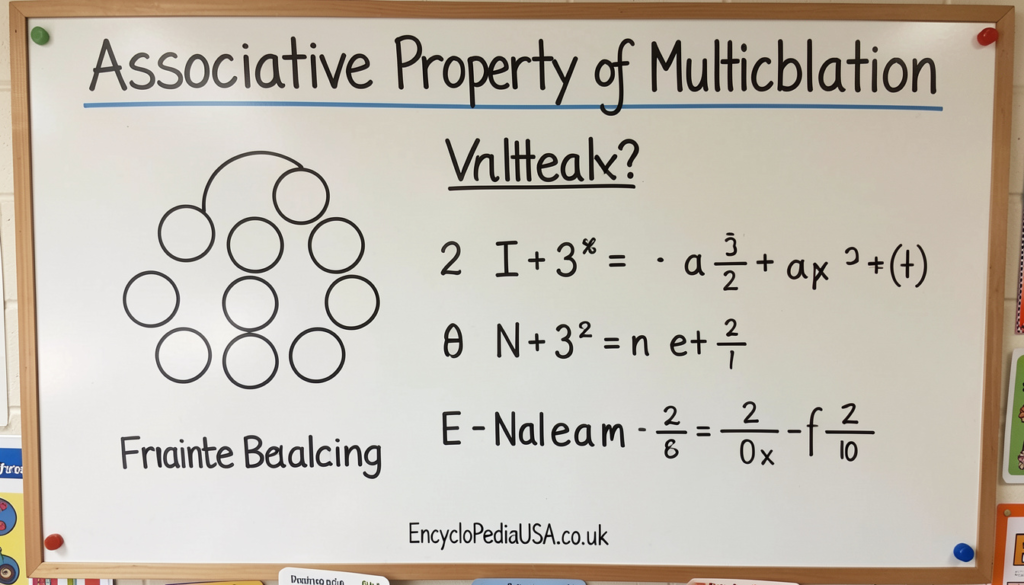
The associative property works the same way for multiplication. You can regroup the factors and the product stays the same.
Example: 2 × 3 × 4
- (2 × 3) × 4 = 6 × 4 = 24
- 2 × (3 × 4) = 2 × 12 = 24
Same result, different grouping.
Practical Use in Multiplication
Here’s a real scenario. You’re calculating: 5 × 17 × 2
If you go left to right: (5 × 17) × 2 = 85 × 2 = 170
But if you regroup: 5 × (17 × 2)… actually wait, let’s try: (5 × 2) × 17 = 10 × 17 = 170
Much easier, right? By grouping 5 and 2 together first, you get 10 — a much friendlier number to multiply with. The associative property gives you that flexibility.
This is a huge advantage in mental math, especially when you’re working with larger numbers or doing calculations on the fly.
The Associative Property Formula: Breaking It Down
Let’s get a little more formal for a moment, just so you have the structure clearly in your head.
Associative Property of Addition Formula: (A + B) + C = A + (B + C)
Associative Property of Multiplication Formula: (A × B) × C = A × (B × C)
These formulas apply to all real numbers — integers, fractions, decimals, negative numbers, and even variables in algebra. As long as you’re adding or multiplying, the associative property holds true.
What About Variables?
The associative property works perfectly in algebra too. If you have:
(x + y) + z = x + (y + z)
This is valid for any values of x, y, and z. It’s one reason why algebraic simplification is possible. You can regroup terms freely during addition and multiplication without changing the equation’s meaning.
Does the Associative Property Apply to Subtraction and Division?
Here’s where people often get tripped up. The associative property does not apply to subtraction or division. Let me show you why.
Subtraction Example:
Take: (10 − 4) − 2
- (10 − 4) − 2 = 6 − 2 = 4
- 10 − (4 − 2) = 10 − 2 = 8
Different answers. So no, the associative property does not hold for subtraction.
Division Example:
Take: (24 ÷ 6) ÷ 2
- (24 ÷ 6) ÷ 2 = 4 ÷ 2 = 2
- 24 ÷ (6 ÷ 2) = 24 ÷ 3 = 8
Again, completely different results. This is a critical distinction. The associative property only works with addition and multiplication. Applying it to subtraction or division is one of the most common math mistakes students make.
Associative Property vs. Commutative Property: What’s the Difference?
These two properties often get confused with each other. They’re related but not the same thing.
The commutative property says you can change the order of numbers and get the same result.
- Addition: a + b = b + a → 3 + 5 = 5 + 3
- Multiplication: a × b = b × a → 4 × 7 = 7 × 4
The associative property says you can change the grouping of numbers and get the same result.
- Addition: (a + b) + c = a + (b + c)
- Multiplication: (a × b) × c = a × (b × c)
Think of it this way: the commutative property is about swapping positions, while the associative property is about changing brackets. Both are useful. Both apply only to addition and multiplication. But they describe different things.
Associative Property vs. Distributive Property
Another property that often gets lumped in with this discussion is the distributive property. Let’s clear that up too.
The distributive property involves both addition and multiplication together. It says:
a × (b + c) = (a × b) + (a × c)
Example: 3 × (4 + 5) = (3 × 4) + (3 × 5) = 12 + 15 = 27
This is different from the associative property, which only involves one operation at a time. The distributive property is about spreading (or distributing) multiplication across addition. It’s a separate rule with a different structure.
Knowing all three — associative, commutative, and distributive — gives you a solid toolkit for simplifying math problems at any level.
How the Associative Property Is Used in Algebra
Once you move into algebra, the associative property becomes especially powerful. You use it constantly when simplifying expressions, combining like terms, and solving equations.
Here’s a simple algebraic example:
Simplify: (3x + 2x) + 5x
Using the associative property: 3x + (2x + 5x) = 3x + 7x = 10x
You’re free to regroup the terms because it’s all addition. The result is the same regardless of how you group them.
Associative Property in Matrix Operations
Interestingly, the associative property also applies to matrix multiplication — but notably, matrix multiplication does not have the commutative property. This distinction becomes important in linear algebra and computer graphics. For matrices A, B, and C:
(A × B) × C = A × (B × C)
The grouping can change, but the order cannot (unlike with regular numbers). This shows just how foundational the associative property is even in advanced mathematics.
Common Mistakes Students Make with the Associative Property
Let’s go over some of the mistakes that come up most often, so you can avoid them.
Mistake 1: Applying it to subtraction or division. As we covered, this doesn’t work. Always double-check which operation you’re working with.
Mistake 2: Confusing it with the commutative property. Regrouping is not the same as reordering. Make sure you know which property you’re applying.
Mistake 3: Thinking the parentheses disappear entirely. The associative property moves the parentheses, it doesn’t eliminate them. You’re still grouping — just differently.
Mistake 4: Assuming it works for all mathematical structures. In some advanced structures (like certain types of abstract algebra), the associative property doesn’t hold. Those are called non-associative operations. But for standard arithmetic and basic algebra, you’re fine.
Real-World Applications of the Associative Property
You might be thinking: “Okay, I get the math. But does this actually matter in the real world?”
Yes — more than you’d think.
In programming and computer science: When a compiler evaluates expressions, it often relies on associativity rules to decide how to group operations for efficiency. Floating-point arithmetic, for example, is technically not fully associative — which is why some numerical calculations in software behave unexpectedly.
In financial calculations: When you’re adding up expenses, revenues, or totals across multiple categories, you naturally group numbers in ways that make the math easier. The associative property is the rule that makes this perfectly valid.
In cooking and recipe scaling: When you’re doubling or tripling a recipe, you’re performing repeated multiplication. Being able to regroup those multiplications makes the mental math much simpler.
In logistics and project planning: Adding time estimates, distances, or resource quantities often involves grouping numbers in convenient chunks. The associative property is what allows this without error.
Teaching the Associative Property to Kids
If you’re a parent or teacher, you might be looking for ways to make this concept stick. Here are a few approaches that work well:
Use physical objects. Have kids group blocks or counters in different ways and count the total each time. Seeing that the total doesn’t change regardless of grouping makes the concept tangible.
Use number lines. Show how jumping different distances in different orders still lands on the same spot.
Use simple word problems that involve three quantities — like combining groups of fruit or dividing toys — and let kids discover that regrouping doesn’t change the outcome.
Repetition through games and practice is key. Once kids internalize the associative property, arithmetic becomes noticeably more flexible and less scary.
Why the Associative Property Is One of the Most Useful Math Rules
I’ll be direct here: the associative property is one of those rules that quietly powers a huge amount of mathematics. It’s not flashy. It doesn’t come with a dramatic formula. But without it, simplifying expressions, combining terms, and doing mental math would all be much harder.
When you understand the associative property — really understand it — you start to see flexibility in numbers that you didn’t notice before. You stop thinking of math as a rigid left-to-right process. You start seeing groupings, shortcuts, and smarter ways to calculate.
That shift in thinking is genuinely valuable, whether you’re a student, a professional, or just someone who wants to be better at everyday arithmetic.
Conclusion
The associative property is a simple but powerful idea: when you’re adding or multiplying, how you group the numbers doesn’t change the answer. That’s it. But the implications of that rule stretch from basic arithmetic all the way into algebra, computer science, and beyond.
To recap the key points: the associative property applies to addition and multiplication, not subtraction or division. It’s different from the commutative and distributive properties. It works with real numbers, variables, and even matrices. And it’s genuinely useful — in the classroom, in everyday life, and in professional fields.
If you’ve been fuzzy on this concept before, I hope this article cleared things up. Math properties like these are the building blocks of everything more complex. Getting them right early on makes a real difference.
What’s a math rule or concept you’ve always wanted explained more clearly? Drop it in the comments — I’d love to tackle it next.
Frequently Asked Questions (FAQs)
Q1: What is the associative property in simple terms? The associative property says that when you add or multiply three or more numbers, the way you group them doesn’t change the final answer. For example, (2 + 3) + 4 gives the same result as 2 + (3 + 4).
Q2: Does the associative property work for subtraction? No. The associative property does not apply to subtraction. Changing the grouping in a subtraction problem will give you different answers. For example, (10 − 4) − 2 = 4, but 10 − (4 − 2) = 8.
Q3: What is the difference between associative and commutative properties? The commutative property is about changing the order of numbers (a + b = b + a). The associative property is about changing the grouping of numbers ((a + b) + c = a + (b + c)). They’re related but describe different things.
Q4: Does the associative property apply to division? No. Just like subtraction, division does not follow the associative property. Regrouping numbers in a division problem will change the result.
Q5: Can the associative property be used in algebra? Absolutely. The associative property applies to algebraic expressions involving addition or multiplication. You can regroup variables and constants freely as long as you’re only adding or multiplying.
Q6: What is an example of the associative property of multiplication? A simple example: (2 × 3) × 4 = 6 × 4 = 24, and 2 × (3 × 4) = 2 × 12 = 24. The grouping changes, but the product stays the same.
Q7: Is the associative property the same as the distributive property? No. The distributive property involves distributing multiplication over addition: a × (b + c) = (a × b) + (a × c). The associative property only deals with one operation at a time and is about regrouping, not distributing.
Q8: Why is the associative property important? It gives you flexibility in how you calculate. It allows you to regroup numbers to make mental math easier, simplify algebraic expressions, and solve problems more efficiently.
Q9: Does the associative property apply to matrices? Yes — matrix multiplication is associative. However, unlike regular multiplication, matrix multiplication is not commutative, meaning order still matters even though grouping doesn’t.
Q10: At what grade level is the associative property taught? The associative property is typically introduced in early elementary school (around grades 1–3) for addition, and in grades 3–4 for multiplication. It continues to be used throughout middle school, high school algebra, and beyond.
Also Read: 3 Bedroom Apartments Near Me
| Author: Johan Harwen |
| E-mail: johanharwen314@gmail.com |
| Bio: Johan Harwen is a passionate tourist who has explored countless destinations across the globe. With an eye for hidden gems and local cultures, he turns every journey into an unforgettable story worth sharing. |