
Choose vs Chose: Master These Confusing Words Forever 2026
Introduction
Have you ever paused mid-sentence, wondering whether to write “choose” or “chose”? You’re not alone. These two words trip up even confident writers daily.
The confusion is completely understandable. Choose and chose look almost identical, sound similar, and come from the same root. Yet using the wrong one can make your writing look careless or unprofessional.
Here’s the good news: the difference between choose and chose is actually simple once you understand the pattern. In this guide, I’ll break down everything you need to know about these confusing words. You’ll learn when to use each one, see plenty of real-world examples, and discover memory tricks that stick. By the end, you’ll never second-guess yourself again when choosing between choose and chose.
Understanding Choose vs Chose: The Core Difference
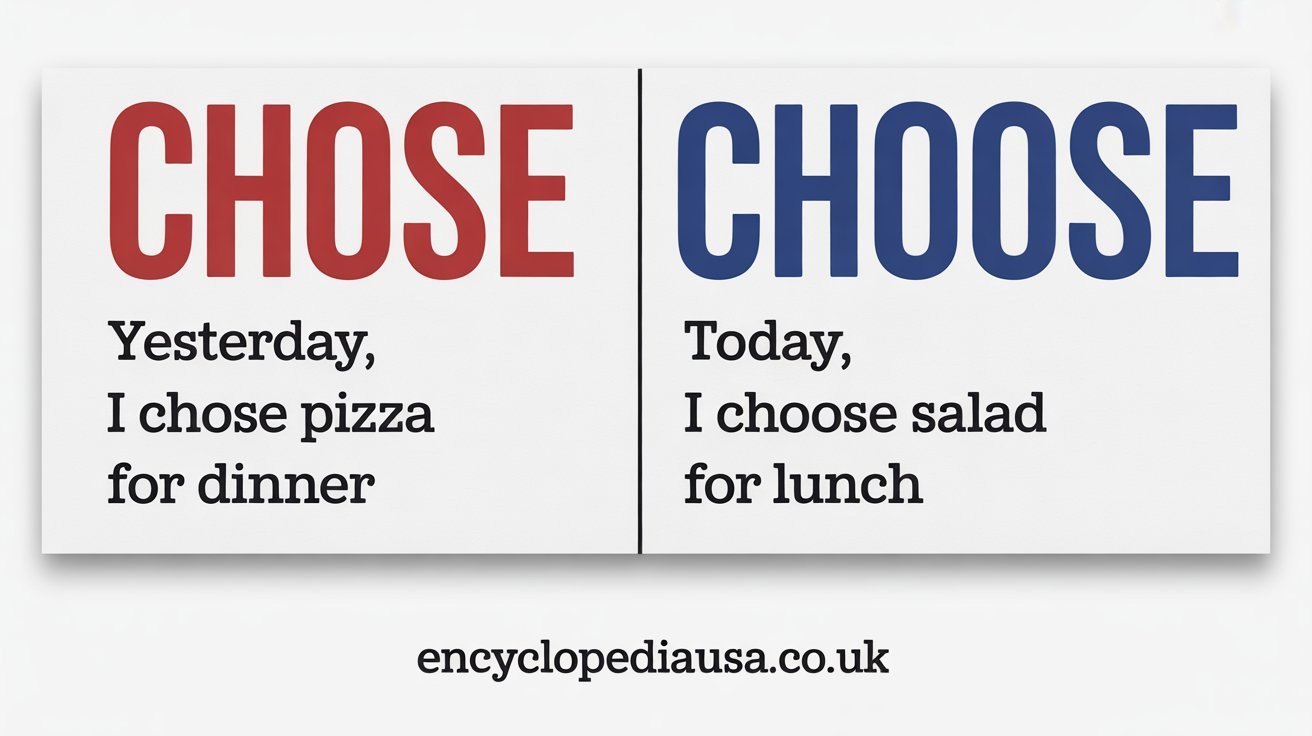
The main difference between choose vs chose comes down to one thing: time.
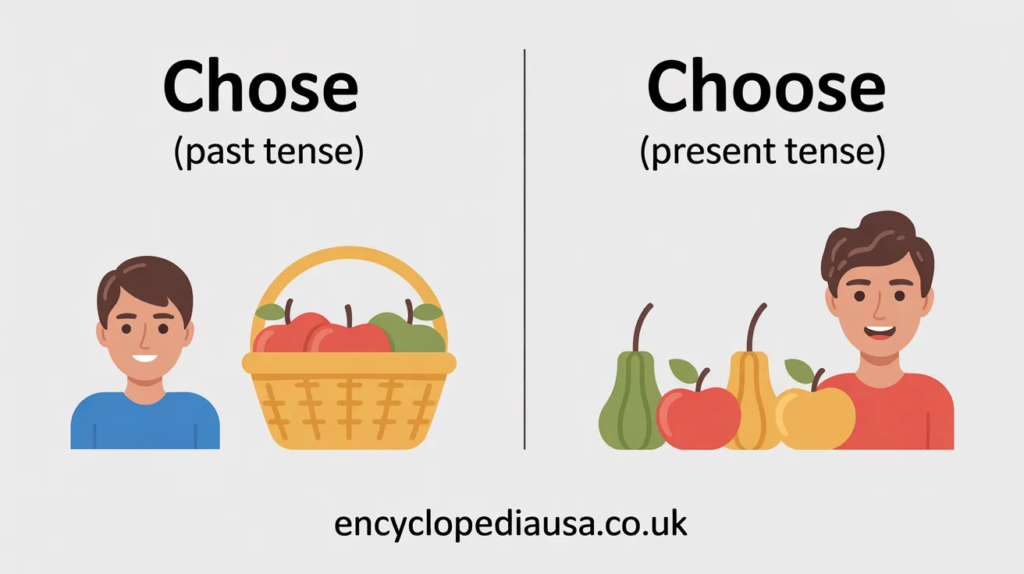
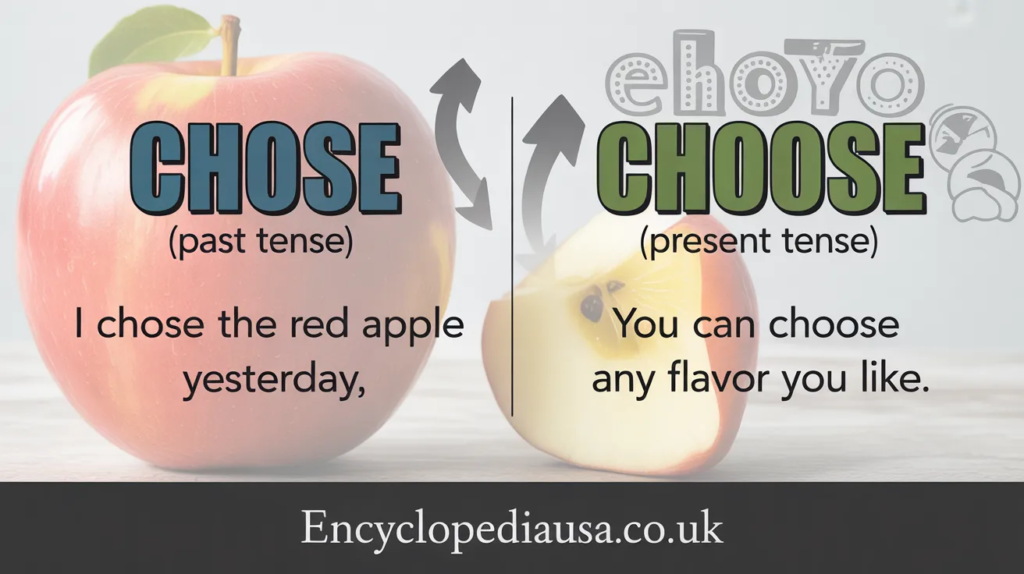
Choose is the present tense form. You use it when talking about decisions happening now or in the future. It rhymes with “snooze” and has that long “oo” sound.
Chose is the past tense form. You use it when talking about decisions that already happened. It rhymes with “hose” and has that long “o” sound.
Think of it this way: if the action is happening now or will happen later, you choose. If the action already happened yesterday, last week, or any time in the past, you chose.
This distinction matters in professional writing, academic papers, emails, and everyday communication. Using the wrong form can confuse your readers about when something happened.
The Pronunciation Key
One helpful trick is focusing on pronunciation. When you say these words out loud, the difference becomes clearer.
- Choose = /chooz/ (sounds like “snooze”)
- Chose = /chohz/ (sounds like “hose” or “rose”)
The vowel sound changes completely. Practice saying them aloud a few times. Your ear will start catching the difference automatically.
When to Use Choose (Present Tense)
Choose is your go-to word for current and future decisions. Let’s break down exactly when you’ll use it.
Present Tense Situations
Use choose when describing what someone does regularly or habitually:
- “I always choose the window seat on flights.”
- “She chooses her words carefully during interviews.”
- “They choose organic vegetables whenever possible.”
These examples show ongoing preferences or repeated actions. The decision-making happens in the present or as a regular pattern.
Future Decisions
Choose also works perfectly for decisions that haven’t happened yet:
- “Tomorrow, I will choose my classes for next semester.”
- “You can choose any book from the shelf.”
- “We need to choose a venue by Friday.”
Notice how these sentences point toward upcoming choices. The action hasn’t occurred yet, so choose is correct.
Commands and Suggestions
When giving instructions or advice, choose is the right pick:
- “Choose wisely before making that investment.”
- “Please choose one option from the menu.”
- “You should choose a password you’ll remember.”
Commands naturally use the base form of verbs, which is choose in this case.
With Helping Verbs
Choose appears after modal verbs (can, could, will, would, should, may, might, must):
- “You can choose your own adventure.”
- “We should choose a different route.”
- “They might choose to stay home tonight.”
The helping verb handles the tense, so choose stays in its base form.
When to Use Chose (Past Tense)
Chose refers exclusively to decisions that already happened. Understanding this context makes usage straightforward.
Past Actions
Use chose when the decision occurred at a specific time in the past:
- “Yesterday, I chose the salmon for dinner.”
- “She chose Harvard over Yale last spring.”
- “They chose to relocate three years ago.”
Each example points to a completed action. The decision is done and dusted.
Storytelling and Narratives
When recounting events or telling stories, chose appears frequently:
- “He chose the red pill, and everything changed.”
- “The committee chose five finalists from hundreds of applicants.”
- “I chose to pursue medicine after volunteering at the hospital.”
Past-tense narration requires chose consistently. You’re describing what happened, not what happens.
Historical or Completed Events
For any event that’s finished, chose is appropriate:
- “The voters chose a new mayor in 2024.”
- “She chose independence over security in her twenties.”
- “Our ancestors chose to migrate across continents.”
These decisions are historical facts. They can’t be changed, so past tense fits perfectly.
Cause and Effect Statements
When explaining why something is the way it is now, chose often appears:
- “Because he chose that career path, he’s now an expert in the field.”
- “I chose not to attend college, which led me to start my own business.”
- “They chose the cheaper option, and now they’re dealing with repairs.”
The past choice created the present situation.
Choose vs Chose: Side-by-Side Examples
Sometimes seeing direct comparisons helps cement the difference. Here are paired examples:
Present vs Past:
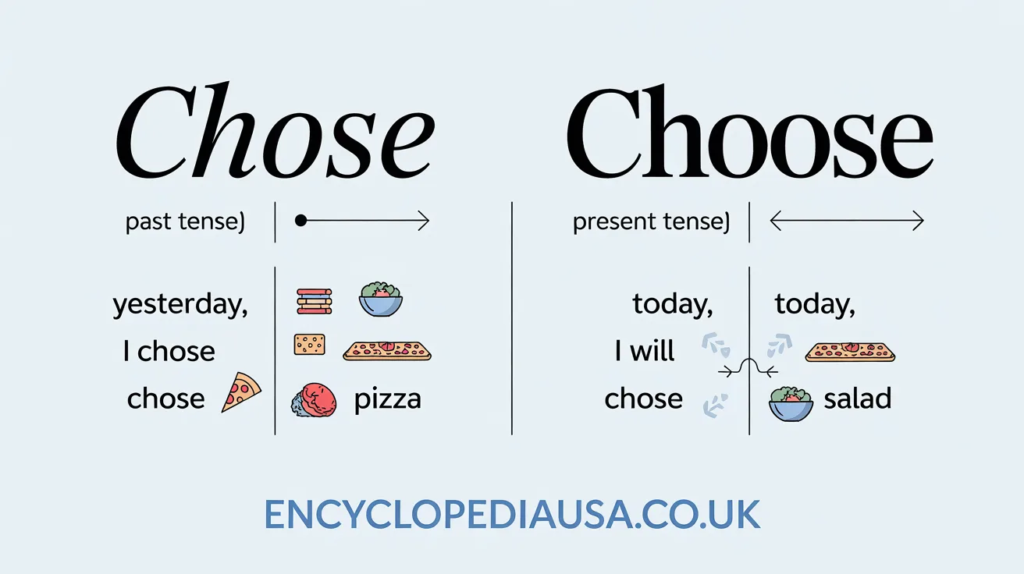
- “I choose tea over coffee.” (my current preference)
- “I chose tea over coffee.” (what I picked earlier today)
Future vs Past:
- “We will choose a leader tomorrow.” (hasn’t happened yet)
- “We chose a leader yesterday.” (already completed)
Habit vs One-Time Event:
- “He chooses the same lunch every day.” (regular pattern)
- “He chose a different lunch today.” (specific past instance)
Ongoing vs Completed:
- “You choose your own destiny.” (general truth, present)
- “You chose your own destiny.” (you already made the decision)
These comparisons show how context determines which word fits. Pay attention to timing clues in your sentences.
Common Mistakes to Avoid
Even knowing the rule, people still mix up choose and chose. Here are the most frequent errors.
Mistake #1: Using Choose for Past Events
Incorrect: “Last month, I choose to quit my job.”
Correct: “Last month, I chose to quit my job.”
Time markers like “last month” signal past tense. Chose is the only option.
Mistake #2: Using Chose After Modal Verbs
Incorrect: “You should chose carefully.”
Correct: “You should choose carefully.”
Modal verbs (should, can, will, must) always pair with the base form: choose.
Mistake #3: Mixing Tenses in One Sentence
Incorrect: “Yesterday I choose a book, and today I chose a movie.”
Correct: “Yesterday I chose a book, and today I chose a movie.”
Keep tense consistent with timing. Both actions happened in the past.
Mistake #4: Confusing “Have Chosen” with Chose
Incorrect: “I have chose the blue one.”
Correct: “I have chosen the blue one.”
Present perfect tense uses “chosen” (the past participle), not chose. We’ll cover this more below.
Chosen: The Third Form You Need to Know
To truly master this word family, you need to understand chosen, the past participle form.
Chosen appears in perfect tenses and passive voice constructions:
Present Perfect:
- “I have chosen my major.”
- “They have chosen a new leader.”
Past Perfect:
- “She had chosen her dress before the sale started.”
- “We had already chosen sides when you arrived.”
Future Perfect:
- “By next week, I will have chosen a topic for my thesis.”
Passive Voice:
- “The winner was chosen by random draw.”
- “You were chosen for this opportunity.”
Remember: the pattern is choose (present), chose (past), chosen (past participle). All three have different uses.
Never say “have chose” or “was chose.” It’s always “have chosen” or “was chosen.”
Memory Tricks That Actually Work
Want to never confuse choose and chose again? Try these mental shortcuts.
The “OO” vs “O” Trick
- Choose has two O’s and refers to decisions with two possibilities: now or later.
- Chose has one O and refers to one time in the past.
The Rhyme Method
- Choose rhymes with “snooze” (both present actions you do)
- Chose rhymes with “froze” (both past tense)
If you can remember “froze” is past tense of “freeze,” you’ll remember “chose” is past tense of “choose.”
The Sentence Substitution Test
When unsure, try substituting a similar verb you know well:
- “I [choose/chose] pizza” → “I [pick/picked] pizza”
- If “pick” sounds right, use choose.
- If “picked” sounds right, use chose.
The Question Method
Ask yourself: “Has this happened yet?”
- If no → choose
- If yes → chose
This simple yes/no question works every time.
Choose vs Chose in Different Contexts
Let’s see how these words function across various writing situations.
Business Writing
Professional communication demands precision:
- “We choose our partners based on shared values.” (company policy, present)
- “The board chose to expand into Asian markets.” (past decision)
- “Please choose a meeting time that works for everyone.” (request, future)
Using the wrong tense in business contexts can create confusion about deadlines, decisions, or policies.
Academic Writing
Research papers and essays often mix tenses:
- “The researcher chose a qualitative approach.” (describing past methodology)
- “Students must choose between two exam formats.” (explaining current options)
- “The study shows that people choose familiarity over novelty.” (reporting general findings)
Academic clarity requires matching verb tense to the temporal context of each statement.
Creative Writing
Fiction writers use both forms constantly:
- “Every morning, I choose hope over despair.” (character’s ongoing philosophy)
- “On that fateful night, she chose revenge.” (plot point)
- “He can choose to walk away, but he won’t.” (character ability, present)
Narrative flow depends on correct tense usage. Past-tense stories use chose; present-tense stories use choose.
Casual Conversation
Even informal writing benefits from accuracy:
- “I always choose the spicy option lol”
- “Why did you chose that? Wait, I mean choose!”
- “Chose the wrong line at the store again 😑”
While casual writing is more forgiving, using the right form still communicates more clearly.
Related Words and Forms
Understanding the complete conjugation helps prevent errors.
Simple Present: choose (I/you/we/they choose; he/she/it chooses)
Simple Past: chose (for all subjects)
Present Participle: choosing (for progressive tenses)
Past Participle: chosen (for perfect tenses and passive voice)
Examples:
- “I am choosing between two offers.” (present progressive)
- “You were choosing your outfit when I called.” (past progressive)
- “The path has been chosen for us.” (present perfect passive)
- “By choosing wisely, you avoid regret.” (gerund)
Knowing these forms prevents confusion in complex sentences.
Practice Exercises
Test your understanding with these fill-in-the-blank sentences. (Answers at the end of this section.)
- “Last year, I _____ to study abroad.”
- “You can _____ any color you like.”
- “She always _____ quality over quantity.”
- “They had already _____ their destination.”
- “We should _____ a restaurant for dinner.”
- “He _____ the wrong answer on the test yesterday.”
- “The jury will _____ a verdict soon.”
- “I have _____ to move forward with the plan.”
Answers: 1. chose, 2. choose, 3. chooses, 4. chosen, 5. choose, 6. chose, 7. choose, 8. chosen
Why This Distinction Matters
You might wonder if one small word really makes such a difference. It does.
Clear communication relies on accurate verb tenses. When you write “I choose” versus “I chose,” you’re telling readers when something happened. Mixing these up creates temporal confusion.
In professional settings, grammatical precision reflects attention to detail. A resume that says “I choose this career path” instead of “I chose this career path” raises questions about your language skills.
For non-native English speakers, mastering choose vs chose builds confidence. English verb tenses are tricky, but conquering common pairs like this one improves overall fluency.
Even native speakers benefit from refreshing these rules. We often rely on what “sounds right” without knowing why. Understanding the grammar behind our choices makes us more intentional, effective writers.
Conclusion
The difference between choose and chose is simpler than you might have thought. Choose is present and future; chose is past. That’s the core rule.
Remember the pronunciation difference: choose rhymes with “snooze,” chose rhymes with “hose.” Think of the two O’s in choose representing two time frames (now and later), while the single O in chose represents one moment in the past.
With the examples, memory tricks, and practice exercises in this guide, you now have everything you need to use these words correctly. The next time you’re writing and pause over “choose or chose,” you’ll know exactly which one fits.
Language mastery comes from understanding these small but important distinctions. You’ve just leveled up your English skills. Now it’s your turn to choose how you’ll use this knowledge—or should I say, now that you’ve chosen to read this article, you’re better equipped than ever before.
Frequently Asked Questions
What is the main difference between choose and chose?
Choose is the present tense form used for current or future decisions, while chose is the past tense form used for decisions that already happened. Choose rhymes with “snooze” and chose rhymes with “hose.”
How do you use choose in a sentence?
Use choose for present or future actions: “I choose tea over coffee,” “You can choose any option,” or “We will choose a winner tomorrow.” Choose follows modal verbs like can, should, will, and must.
When should I use chose instead of choose?
Use chose when referring to past decisions or completed actions: “I chose the red dress yesterday,” “She chose to study medicine,” or “They chose a different path years ago.”
What is the past participle of choose?
The past participle of choose is “chosen,” used in perfect tenses and passive voice: “I have chosen,” “It was chosen,” or “They had chosen.” Never say “have chose”—it’s always “have chosen.”
Can you say “have chose”?
No, “have chose” is grammatically incorrect. The correct form is “have chosen.” Use chosen (the past participle) after helping verbs like have, has, and had, not chose.
Why do people confuse choose and chose?
People confuse these words because they look similar, come from the same root, and sound alike. The pronunciation difference is subtle, and many writers rely on visual memory without considering tense, leading to common mix-ups.
Is it “choose wisely” or “chose wisely”?
It’s “choose wisely.” When giving commands or advice, use the base form (present tense): choose. You’re instructing someone about a decision they haven’t made yet, so present tense is correct.
How do you pronounce choose vs chose?
Choose is pronounced “chooz” (rhymes with “snooze”). Chose is pronounced “choze” (rhymes with “hose” or “nose”). The vowel sound changes from “oo” to “oh.”
What tense is “choosing”?
“Choosing” is the present participle form, used in progressive/continuous tenses: “I am choosing,” “They were choosing,” “We will be choosing.” It indicates ongoing action at a specific time.
Can choose be used for the future?
Yes, choose can express future decisions: “I will choose tomorrow,” “You can choose later,” or “We need to choose by Friday.” The base form choose works with future-indicating words and modal verbs.
Also Read : Blaze Alexander