
Commutative Property: The Simple Rule That Powerfully Unlocks Math
Introduction
Have you ever switched the order of two numbers while adding them together, just to make the mental math easier? Maybe you added 3 + 97 instead of 97 + 3. If you have, you already understand the commutative property, even if you never called it by that name.
The commutative property is one of the most fundamental rules in mathematics. It tells you that the order of numbers does not change the result when you are adding or multiplying them. It sounds almost too simple to matter, but this single idea is at the heart of how we solve equations, build algorithms, and make everyday calculations faster.
In this article, you will discover what the commutative property really means, see how it works across addition and multiplication, explore where it does not apply, and find out why understanding it deeply gives you a real edge in math and beyond. Whether you are a student brushing up on basics, a parent helping with homework, or just someone who wants to finally understand why math works the way it does, this guide is for you.
What Is the Commutative Property?
The commutative property is a rule in mathematics that says you can change the order of numbers in an operation without changing the result. The word commutative comes from the Latin word “commutare,” which means to exchange or switch. That is exactly what this property lets you do.
There are two main versions of this property. One applies to addition, and the other applies to multiplication. Both are used constantly in everyday math.
Commutative Property of Addition
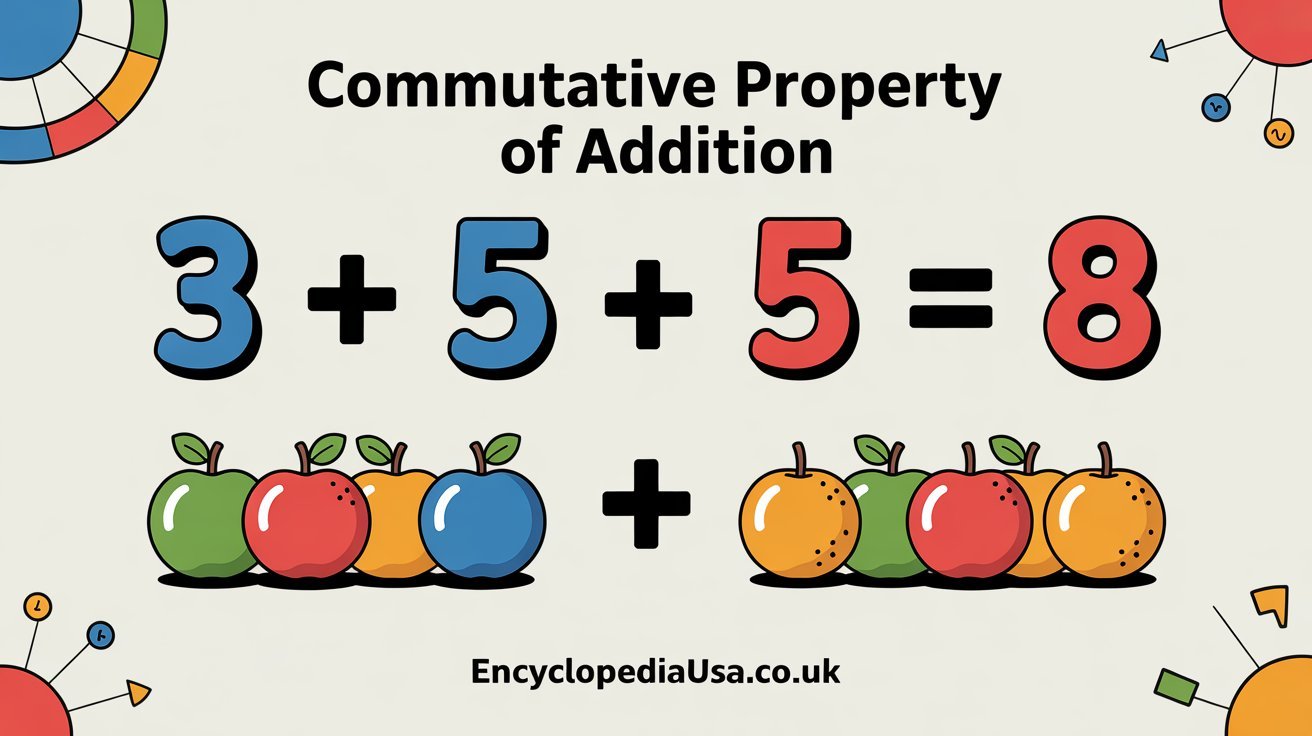
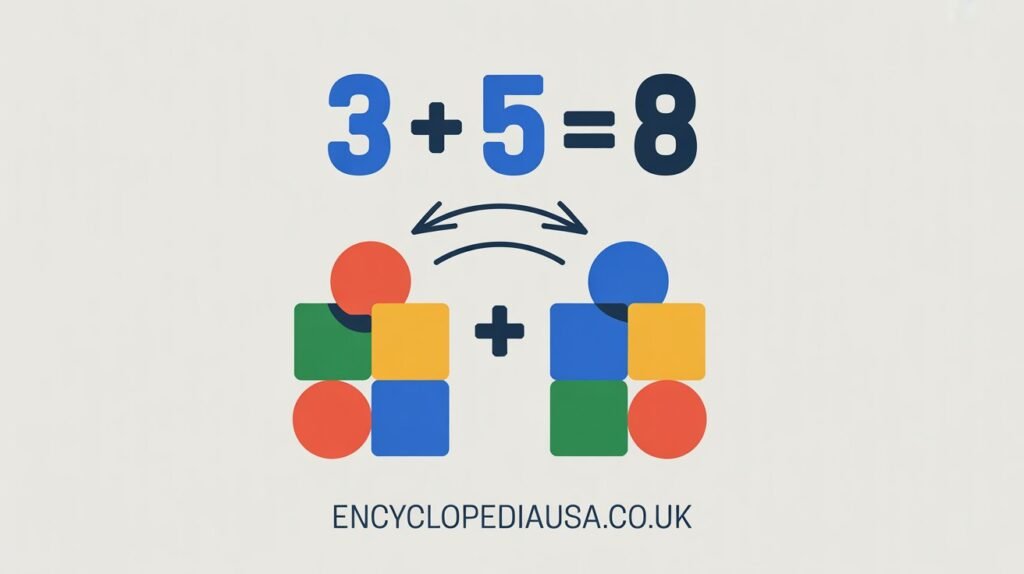
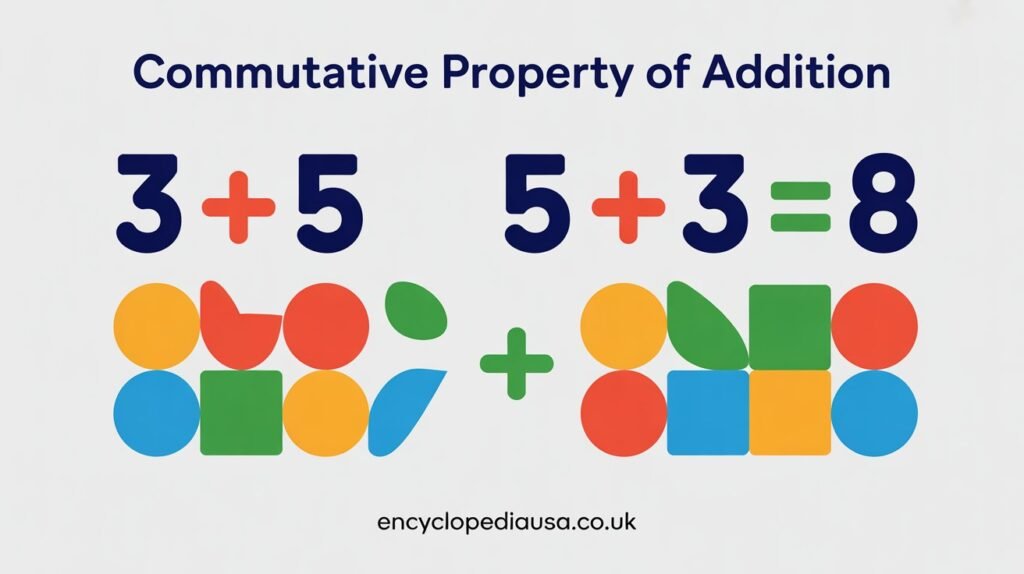
The commutative property of addition states that a + b = b + a. It does not matter which number comes first. The sum will always be the same.
Here are a few clear examples:
⦁ 4 + 9 = 13 and 9 + 4 = 13
⦁ 25 + 75 = 100 and 75 + 25 = 100
⦁ 100 + 1 = 101 and 1 + 100 = 101
Notice how the numbers swap positions, but the answer stays exactly the same. This is the commutative property working in its simplest form.
Commutative Property of Multiplication
The commutative property of multiplication works the same way. It states that a x b = b x a. You can multiply numbers in any order and still get the same product.
Some quick examples:
⦁ 6 x 7 = 42 and 7 x 6 = 42
⦁ 3 x 12 = 36 and 12 x 3 = 36
⦁ 9 x 5 = 45 and 5 x 9 = 45
This property is especially useful when you are trying to simplify a multiplication problem. If one arrangement is easier for you to compute mentally, you can use it without worrying about getting the wrong answer.
Why Does the Commutative Property Matter So Much?
You might be thinking this seems obvious. Of course 3 + 5 equals 5 + 3. But the deeper significance of this property goes far beyond simple arithmetic.
In algebra, the commutative property allows you to rearrange terms in an equation to group like terms together. This makes simplification much easier. For example, if you have an expression like 2x + 5 + 3x, you can rearrange it to 2x + 3x + 5 using the commutative property, and then simplify it to 5x + 5.
In computer science, the commutative property is foundational to building efficient algorithms. Sorting algorithms, data structures, and parallel computing systems all rely on understanding which operations are commutative and which are not.
In everyday life, this property shows up constantly. When you are splitting a bill, rearranging items in a shopping cart, or calculating travel distances, the commutative property is quietly making your mental math smoother.
Where the Commutative Property Does Not Work
Here is where things get really interesting, and where many students make serious mistakes. The commutative property only applies to addition and multiplication. It does not apply to subtraction or division.
Subtraction Is Not Commutative
Try it yourself. Is 10 minus 4 the same as 4 minus 10? Absolutely not. 10 minus 4 equals 6, but 4 minus 10 equals negative 6. The order matters completely here, and switching it gives you a completely different answer.
This is one of the most common misconceptions students carry into algebra. They assume that what works for addition must work for everything else. It does not, and catching this mistake early saves a lot of frustration later.
Division Is Not Commutative Either
The same issue applies to division. 20 divided by 4 equals 5. But 4 divided by 20 equals 0.2. Those are two very different numbers. The position of each number in a division problem changes everything.
Understanding this distinction helps you approach equations more carefully. You know exactly which operations give you flexibility and which ones demand precision in ordering.
Real Life Examples of the Commutative Property
Math concepts feel a lot more meaningful when you can see them working in the world around you. The commutative property is not just a classroom rule. It shows up in situations you deal with every single day.
Grocery Shopping and Budgeting
Imagine you are at the store with a budget of $50. You pick up items costing $12, $18, and $20. You can add those numbers in any order you like. $12 + $18 + $20 gives you the same total as $20 + $12 + $18. The order you add them in does not change the total.
This might seem trivial, but it matters when you are doing the mental math at checkout and want to group numbers that add up easily. The commutative property gives you that freedom.
Cooking and Recipes
When a recipe tells you to add 2 cups of flour and 1 cup of sugar, the order in which you measure them does not change the total amount you are working with. 2 + 1 is the same as 1 + 2. The commutative property applies to many mixing and combining scenarios in the kitchen.
Scheduling and Planning
When you are planning a day with multiple tasks, the total time those tasks take does not change based on the order you do them. If task A takes 30 minutes and task B takes 45 minutes, doing A then B or B then A still takes 75 minutes total. That is the commutative property in your calendar.
How Students Can Use the Commutative Property to Learn Faster
One of the best things about the commutative property is how much it simplifies learning multiplication tables. I remember finding certain multiplication facts hard to recall. But once I realized that 7 x 8 and 8 x 7 are the same thing, I only had to memorize one of them.
Research in math education supports this approach. Studies show that students who understand the underlying properties of operations learn arithmetic more efficiently and with better retention than those who rely purely on rote memorization. The commutative property is one of those foundational ideas that makes a real difference.
Here are some practical ways to use it while studying:
- When memorizing addition facts, learn each pair once. If you know 6 + 8, you already know 8 + 6.
- When practicing multiplication tables, recognize that learning rows also teaches columns.
- When solving multi-step problems, rearrange numbers to create easier groupings before calculating.
- When checking your work, try the problem in reverse order to verify your answer.
The Commutative Property in Advanced Math and Science
The concept does not stop at basic arithmetic. As you move into higher mathematics, you will encounter situations where commutativity becomes a defining characteristic of entire mathematical systems.
Algebra and Polynomials
In algebra, the commutative property lets you reorder terms in a polynomial. For example, 3x + 2y + 5 is the same as 5 + 2y + 3x. You can rearrange the terms freely because addition is commutative. This flexibility is essential for factoring, expanding, and simplifying expressions.
Matrix Multiplication and Non-Commutative Operations
In linear algebra, matrix multiplication is famously non-commutative. If you have matrix A and matrix B, the product AB is generally not the same as BA. This is a critical point in advanced mathematics and physics. Understanding what commutativity means makes it much clearer why its absence in matrix multiplication is so significant.
Physics and Quantum Mechanics
Quantum mechanics is full of non-commutative operations. In fact, Heisenberg’s uncertainty principle is directly tied to the fact that certain quantum operators do not commute. Measuring position and then momentum gives a different result than measuring momentum and then position. The idea that order matters in some operations and not others is central to our understanding of the physical universe.
Related Properties You Should Know
The commutative property does not exist in isolation. It is part of a family of fundamental mathematical properties that work together. Knowing all of them gives you a much stronger foundation.
⦁ Associative Property: This property says that how you group numbers in addition or multiplication does not change the result. For example, (2 + 3) + 4 equals 2 + (3 + 4). Both equal 9.
⦁ Distributive Property: This property connects multiplication and addition. It states that a(b + c) equals ab + ac. This is one of the most used properties in algebra.
⦁ Identity Property: Adding 0 to any number leaves it unchanged. Multiplying any number by 1 leaves it unchanged. These are the additive and multiplicative identities.
⦁ Inverse Property: Every number has an additive inverse (adding gives zero) and a multiplicative inverse (multiplying gives one). These concepts are crucial in solving equations.
Understanding how all these properties relate to each other is what separates students who truly get math from those who are just memorizing steps.
Teaching the Commutative Property to Young Learners
If you are a parent or teacher, you already know that abstract rules do not land well with young children. The commutative property needs to be made concrete and visual before kids can truly grasp it.
Here are some approaches that actually work well with young learners:
⦁ Use objects: Place 4 apples on the left and 2 on the right. Count them. Then switch the piles. Count again. The total is always 6, and that physical experience makes the rule real.
⦁ Draw it: Let kids draw two groups of dots and combine them in different orders. Seeing the same total appear reinforces the concept visually.
⦁ Use stories: Tell a story where a character collects 3 red marbles and then 5 blue ones. Then tell it the other way around. Ask whether the total is different. Kids love narrative, and it makes abstract rules memorable.
⦁ Make it a game: Create simple card games where students match equivalent addition or multiplication sentences written in different orders.
Conclusion
The commutative property is one of those ideas that seems small until you realize how deeply it runs through all of mathematics. It tells you that for addition and multiplication, the order of numbers is flexible. You can rearrange, regroup, and recalculate in whatever way makes the most sense to you.
But knowing what it does not cover is just as important. Subtraction and division are not commutative, and forgetting that distinction leads to errors that cascade through more complex problems. Understanding both sides of the rule gives you a clear, confident grip on how numbers behave.
Whether you are helping a child discover math for the first time, strengthening your own foundations, or exploring how this rule scales into advanced mathematics, the commutative property is worth knowing well. It is one of those concepts that keeps giving the more you understand it.
Now that you know how it works, where does the commutative property show up most in your daily life or work? Think about it. You might be surprised how often you are already using it without realizing it. Feel free to share this article with someone who is learning math or looking to fill in the gaps in their foundational knowledge.
Frequently Asked Questions (FAQs)
- What is the commutative property in simple terms?
The commutative property means that when you add or multiply numbers, the order you put them in does not change the answer. So 5 + 3 and 3 + 5 both equal 8, and 4 x 6 and 6 x 4 both equal 24. - Does the commutative property apply to subtraction?
No. Subtraction is not commutative. The order of the numbers matters. For example, 10 minus 3 equals 7, but 3 minus 10 equals negative 7. Those are very different results. - Does the commutative property apply to division?
No. Division is not commutative either. 12 divided by 4 equals 3, but 4 divided by 12 equals one third. The order you write the numbers in completely changes your answer. - What is the formula for the commutative property?
For addition: a + b = b + a. For multiplication: a x b = b x a. These formulas show that swapping the positions of numbers does not affect the result. - What is the difference between the commutative and associative properties?
The commutative property is about changing the order of numbers. The associative property is about changing the grouping of numbers. For example, (2 + 3) + 4 equals 2 + (3 + 4) is the associative property. Both apply to addition and multiplication, but they address different kinds of rearrangement. - Why is it called the commutative property?
The word commutative comes from the Latin word commutare, meaning to switch or exchange. The name reflects exactly what the property allows you to do: switch the positions of numbers in an addition or multiplication operation without changing the outcome. - Is the commutative property used in algebra?
Yes, very frequently. In algebra, the commutative property lets you reorder terms in an expression. This is essential when you are combining like terms, simplifying equations, or rearranging expressions to make them easier to work with. - Can the commutative property be applied to fractions?
Yes. The commutative property works with fractions just like it works with whole numbers. One half plus three quarters equals three quarters plus one half. The same goes for multiplying fractions. - Do negative numbers follow the commutative property?
Yes. Negative numbers follow the commutative property for addition and multiplication. For example, negative 5 plus 3 equals 3 plus negative 5. Both equal negative 2. The property holds regardless of whether the numbers are positive or negative. - How do I explain the commutative property to a child?
Use physical objects like blocks or toys. Show the child that putting 3 blocks and 5 blocks together gives the same pile as putting 5 blocks and 3 blocks together. Let them count both ways and see the same total. That hands-on experience makes the concept click much faster than any definition.
Also Read Pasco County Property Appraiser