
Jail vs Prison: The Shocking Truth About America’s System 2026
Introduction
Most people use the terms “jail” and “prison” interchangeably when talking about incarceration. You might hear someone say their friend is “in jail” when they actually mean prison, or vice versa. This confusion is understandable because both facilities hold people who’ve broken the law, but the differences between jail vs prison are actually quite significant.
Understanding the distinction between jail and prison matters more than you might think. If you’re ever called for jury duty, supporting someone facing charges, or simply want to understand how the criminal justice system works, knowing these differences helps you grasp what’s really happening.
The jail vs prison debate isn’t just semantics. These facilities serve different purposes, house different types of offenders, operate under different authorities, and provide vastly different experiences for inmates. In this comprehensive guide, you’ll learn exactly what separates jails from prisons, why these distinctions exist, and what they mean for people caught in the criminal justice system.
What Is a Jail?
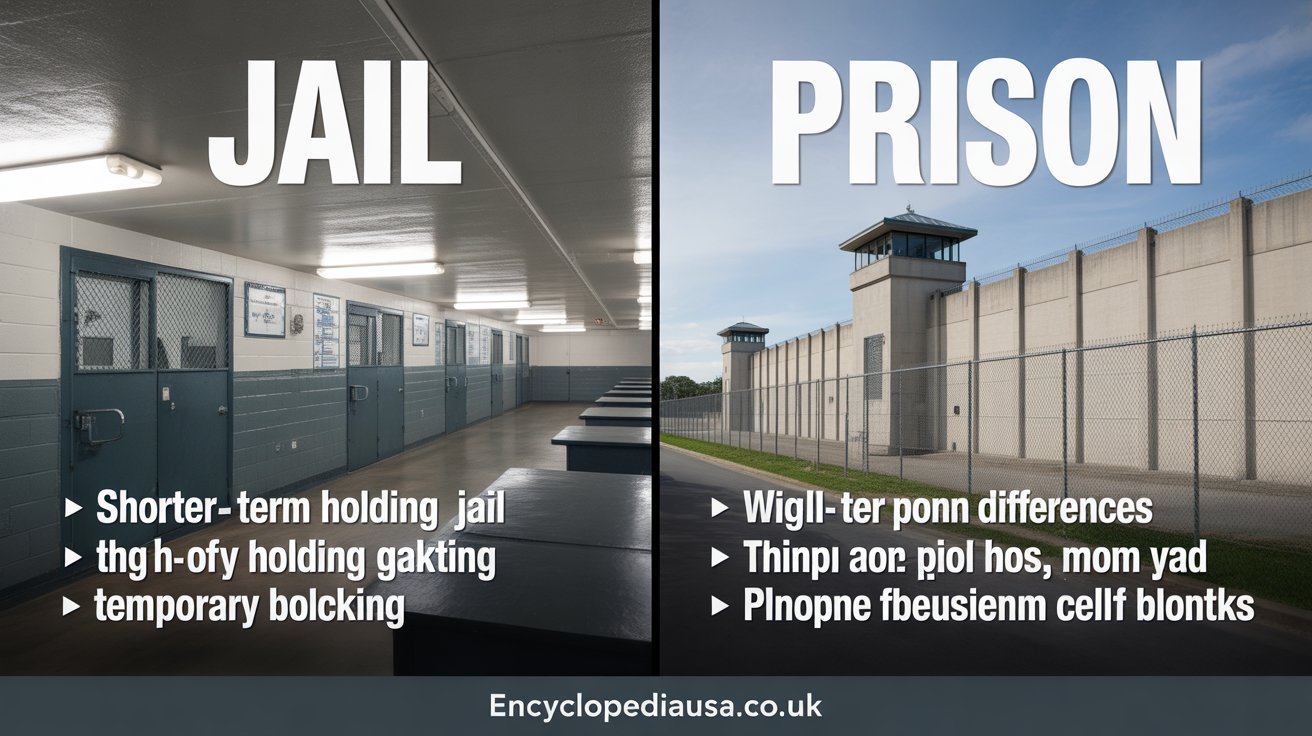
A jail is a short term detention facility typically operated by local law enforcement. When you think of a county jail or city jail, you’re picturing the kind of facility that holds people temporarily. Jails serve multiple purposes within the criminal justice system.
First, jails hold people who’ve been arrested and are awaiting trial. These individuals haven’t been convicted yet. They’re in jail either because they couldn’t post bail or because a judge denied bail altogether. This pretrial detention can last days, weeks, or sometimes months depending on how quickly the case moves through the court system.
Second, jails house people serving short sentences for minor crimes. If you’re convicted of a misdemeanor and sentenced to less than a year, you’ll likely serve that time in a county jail rather than a state prison. These sentences might be for offenses like petty theft, simple assault, or driving under the influence.
Third, jails temporarily hold people awaiting transfer to other facilities. Someone might be in jail waiting to be moved to prison after conviction, or they might be held for another jurisdiction that’s coming to pick them up.
Who Runs Jails?
Local governments operate jails through their sheriff’s departments or local corrections departments. Your county sheriff typically has jurisdiction over the county jail. In some cities, the police department might run a city jail for very short term holding.
This local control means jails vary significantly from place to place. A jail in a large urban county looks and operates differently from one in a rural area. Funding, staffing, and resources depend on local budgets and priorities.
Typical Jail Population
The jail vs prison distinction becomes clearer when you look at who’s inside. Jail populations are extremely fluid. People come and go constantly. Someone might be released on bail after a few hours. Another person might sit in jail for months awaiting trial.
On any given day, a county jail holds a mix of people:
- Individuals arrested recently who haven’t seen a judge yet
- People awaiting trial who couldn’t afford bail
- Convicted misdemeanor offenders serving short sentences
- People violating probation or parole temporarily
- Individuals with mental health issues waiting for treatment placement
- People being held for federal authorities or other jurisdictions
This constant turnover creates challenges for jail administrators. They can’t offer extensive programming or rehabilitation services when people might leave within days.
What Is a Prison?
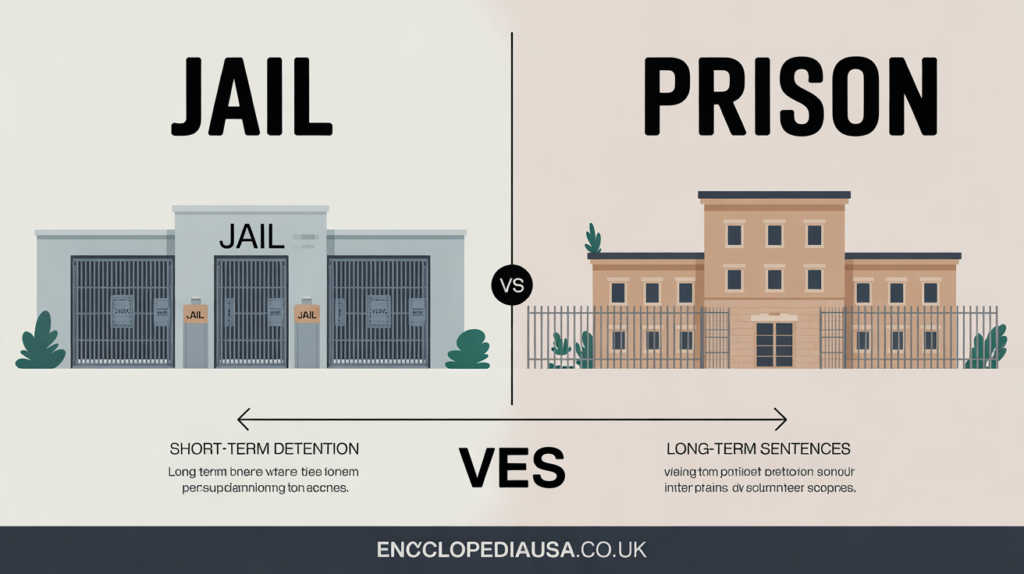
A prison is a long term correctional facility designed to hold people convicted of serious crimes. When we talk about the jail vs prison difference, length of stay is the biggest factor. Prisons house individuals serving sentences of more than a year, often much longer.
Prisons operate at the state or federal level. If you’re convicted of a state felony, you go to a state prison. Federal crimes land you in a federal prison. These facilities are designed for extended incarceration with more comprehensive programs and services than jails offer.
The environment in prison differs significantly from jail. Because people serve longer sentences, prisons provide educational programs, vocational training, work opportunities, and rehabilitation services. The goal is to prepare inmates for eventual release back into society.
Types of Prisons
Not all prisons are the same. The correctional system categorizes prisons based on security level. This classification affects every aspect of an inmate’s experience.
Minimum security prisons house non-violent offenders considered low risk. These facilities might look more like college campuses than the prisons you see in movies. Inmates often live in dormitory style housing rather than cells. They have more freedom of movement and access to programs.
Medium security prisons hold inmates who need more supervision but aren’t considered maximum security risks. These facilities have more restrictions, stronger perimeters, and more controlled movement than minimum security institutions.
Maximum security prisons house violent offenders and those deemed high security risks. These are the fortified institutions with high walls, armed guards, and strict protocols. Inmates live in individual cells and have limited movement and programming opportunities.
Supermax prisons represent the highest security level. These facilities hold the most dangerous offenders in near total isolation. Inmates spend 23 hours per day in their cells with minimal human contact.
Federal vs State Prisons
The jail vs prison conversation also includes federal versus state distinctions. Federal prisons hold people convicted of federal crimes like drug trafficking across state lines, bank robbery, or federal fraud. The Federal Bureau of Prisons operates these facilities.
State prisons hold people convicted of state crimes like murder, rape, robbery, or assault. Each state runs its own prison system with its own policies and procedures. Conditions and programs vary widely between states.
Federal prisons generally have better funding, newer facilities, and more comprehensive programs than many state prisons. However, federal sentences often run longer with less opportunity for early release.
Key Differences Between Jail vs Prison
Let’s break down the major distinctions that separate jails from prisons. Understanding these differences clarifies how the criminal justice system actually works.
Length of Incarceration
This is the most fundamental difference in the jail vs prison comparison. Jails hold people short term, typically less than one year. Prisons hold people long term, usually more than one year and often much longer.
If you’re sentenced to six months for a DUI, you’ll serve that time in county jail. If you’re sentenced to five years for robbery, you’ll serve that time in state prison. This distinction affects everything about the incarceration experience.
Purpose and Function
Jails serve as temporary holding facilities. They’re designed to detain people awaiting trial and house short term offenders. Jails don’t focus heavily on rehabilitation because of the short, unpredictable stays.
Prisons focus on long term incarceration and rehabilitation. Because inmates serve years rather than months, prisons offer educational opportunities, job training, substance abuse treatment, and mental health services. The goal is preparing people for eventual release.
Jurisdiction and Operation
Local governments run jails through sheriff’s departments or corrections departments. State or federal governments operate prisons through dedicated corrections agencies. This difference affects funding, oversight, and accountability.
Security Levels
Most jails operate at one security level with some segregation for dangerous inmates. Prisons are specifically categorized by security level from minimum to supermax. This classification system allows for appropriate placement based on offense and risk.
Living Conditions
Jail vs prison living conditions differ significantly. Jails often use open dormitories or holding cells with multiple occupants. Privacy is minimal and conditions can be crowded.
Prisons generally provide individual cells, especially at higher security levels. While not luxurious, prison cells offer more personal space and storage than jail accommodations. Long term inmates can personalize their space within limits.
Programs and Services
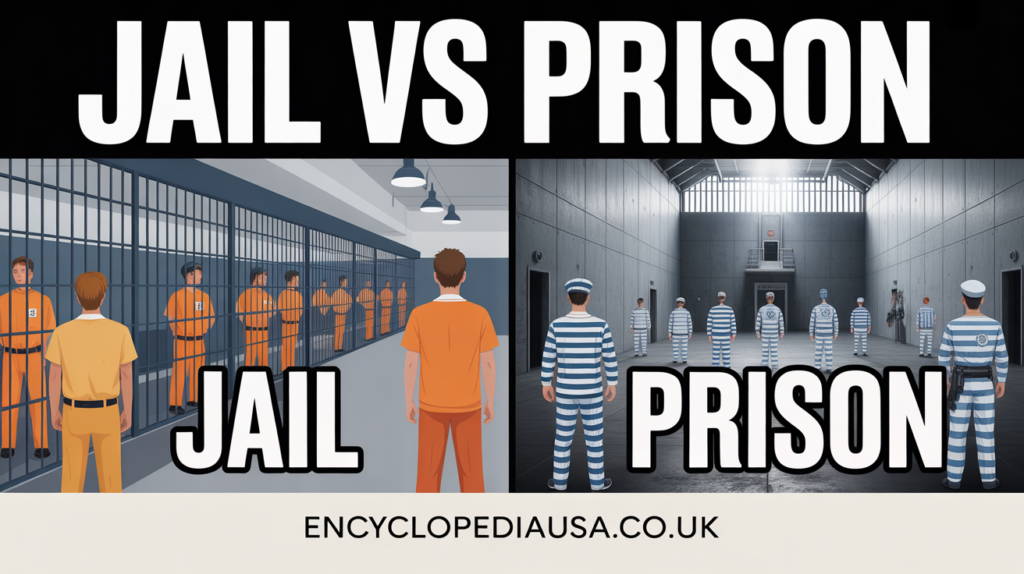
This is where the jail vs prison distinction really matters for inmates. Jails offer minimal programming because of short stays and constant turnover. You might have access to basic medical care, limited recreation, and perhaps GED classes, but that’s often it.
Prisons provide extensive programming including:
- Educational programs from literacy to college courses
- Vocational training in various trades
- Substance abuse treatment programs
- Mental health services
- Religious services and counseling
- Recreation and exercise opportunities
- Prison jobs that teach work skills
These programs help inmates develop skills and address issues that contributed to their criminal behavior.
Visitation and Communication
Prison visitation policies are generally more structured and liberal than jail policies. Because prison inmates serve long sentences, maintaining family connections is considered important for rehabilitation and reentry success.
Jails have more restrictive visitation, often limiting visits to short periods behind glass with phone communication. Prisons may allow contact visits where family members can sit together and embrace.
The Human Impact of Jail vs Prison
The differences between jail and prison profoundly affect the people inside. Understanding these impacts helps you appreciate why the distinction matters beyond technical definitions.
Uncertainty in Jail
Jail can be psychologically harder than prison despite shorter stays. The uncertainty is crushing. If you’re awaiting trial in jail, you don’t know if you’ll be released tomorrow or convicted and sentenced to years in prison. This anxiety affects mental health significantly.
Many people in jail are there simply because they can’t afford bail. They haven’t been convicted of anything. They’re legally innocent but sitting in a cell because they don’t have money. This reality of the jail vs prison system raises serious fairness questions.
Adaptation to Prison
Prison requires adjustment to long term confinement. Inmates develop routines, build relationships, and adapt to the prison environment. While difficult, this adaptation is possible because of the stable, structured environment.
The programs available in prison can be genuinely transformative. I’ve read countless stories of people who learned trades, earned degrees, or addressed addiction issues while incarcerated. These opportunities don’t exist in jail.
Impact on Families
The jail vs prison distinction affects families differently too. Jail’s uncertainty makes it hard for families to plan or cope. Prison’s distance from home communities makes visiting difficult, especially for low income families.
However, prison’s structured visitation at least provides predictability. Families can plan visits knowing the schedule and rules. Jail visitation is often more chaotic and restrictive.
Common Misconceptions About Jail vs Prison
Several myths persist about jails and prisons. Let’s clear up some common confusion.

“Jail is easier than prison”
Many people assume jail is preferable because sentences are shorter. In reality, jail conditions are often worse. Overcrowding is more severe, programs are minimal, and the constant chaos creates stress.
Prison, while still a terrible place to be, at least offers stability and programming. Many people transferred from jail to prison actually experience some relief at having certainty and routine.
“Only violent criminals go to prison”
While prisons do house violent offenders, many prison inmates committed non-violent crimes. Drug offenses send thousands of people to prison each year. Property crimes, fraud, and other non-violent felonies also result in prison sentences.
The jail vs prison split is about sentence length and crime severity, not just violence.
“Federal prison is worse than state prison”
Federal prisons actually tend to have better conditions than state facilities. They’re generally newer, less crowded, and better funded. However, federal sentences often run longer with less chance of early release.
The downside of federal prison is that you might be sent anywhere in the country, far from family. State prisons usually keep inmates within their home state.
The Broader Criminal Justice Context
Understanding jail vs prison requires looking at the bigger picture of mass incarceration in America. The United States has the highest incarceration rate in the world. Over two million people are locked up in jails and prisons combined.
About 740,000 people are in local jails on any given day. Another 1.2 million are in state prisons. Roughly 150,000 are in federal prisons. These numbers have grown dramatically over the past 40 years due to tougher sentencing laws and the war on drugs.
Racial Disparities
The jail vs prison system doesn’t affect all communities equally. Black Americans are incarcerated at five times the rate of white Americans. Latino Americans are incarcerated at 1.3 times the rate of white Americans. These disparities reflect broader inequalities in policing, prosecution, and sentencing.
Reform Movements
Growing awareness of these issues has sparked reform movements. Some areas are reducing jail populations by reforming bail systems. States are shortening sentences and expanding early release programs to reduce prison populations.
These reforms recognize that mass incarceration hasn’t made us safer and has devastated communities, particularly communities of color.
What Happens After Jail or Prison?
The jail vs prison experience doesn’t end at release. People leaving either facility face enormous challenges reintegrating into society.
Those released from jail after short stays may not have lost their housing or jobs. However, even a few days in jail can be devastating if you lose your job or can’t pay rent.
Prison releases present different challenges. After years inside, people struggle with technology changes, social interactions, and finding employment with a felony record. The recidivism rate remains high partly because reentry is so difficult.
Support systems make a huge difference. Halfway houses, job programs, and community support help people successfully transition. Without these resources, many end up back in the jail vs prison cycle.
Conclusion
The differences between jail vs prison extend far beyond terminology. Jails are local, short term facilities holding people awaiting trial and serving brief sentences. Prisons are state or federal long term institutions for convicted felons serving substantial sentences. These distinctions affect every aspect of the incarceration experience from daily conditions to available programs.
Understanding jail vs prison helps you comprehend how the criminal justice system actually functions. It reveals the challenges facing people caught in this system and their families. It also highlights areas where reform could make the system more just and effective.
Whether you’re dealing with the system personally, supporting someone who is, or simply want to be an informed citizen, knowing these differences matters. The next time you hear someone talking about “jail time” or “prison sentences,” you’ll understand exactly what they mean and why it makes a difference.
What changes would you make to the jail and prison system if you had the power? Share your thoughts or pass this information along to someone who might find it useful.
Frequently Asked Questions
What is the main difference between jail and prison?
The main difference is the length of stay. Jails are short term facilities run by local governments that hold people awaiting trial and those serving sentences under one year. Prisons are long term facilities run by state or federal governments that hold convicted felons serving sentences over one year.
Can you choose between jail and prison?
No, you cannot choose. The court determines your sentence, and whether you go to jail or prison depends on the crime severity and sentence length. Misdemeanors typically result in jail time, while felonies result in prison sentences. The criminal justice system makes this determination, not the defendant.
Is jail worse than prison?
Many people find jail harder despite shorter stays. Jails are often more crowded with minimal programs and constant uncertainty. Prisons offer more stability, personal space, and rehabilitation programs. However, both are difficult experiences that no one should take lightly.
How long can you stay in jail before going to prison?
If you’re convicted and sentenced to prison, the transfer typically happens within a few weeks to a few months. However, if you’re awaiting trial, you could remain in jail for many months or even over a year before your case is resolved, depending on the court system’s backlog.
Do federal prisons have better conditions than state prisons?
Generally, yes. Federal prisons tend to be newer, less crowded, and better funded than many state facilities. They also typically have more comprehensive programs. However, federal sentences are often longer with fewer opportunities for early release, and inmates may be sent far from home.
What crimes send you to prison instead of jail?
Felonies typically result in prison sentences. These include violent crimes like murder, rape, and robbery, as well as serious drug offenses, burglary, fraud, and other major crimes. Any crime with a potential sentence over one year usually means prison rather than jail.
Can you work while in jail or prison?
Prison inmates usually have opportunities to work in various prison jobs, from kitchen duty to maintenance to manufacturing. These jobs teach skills and provide small wages. Jail inmates have fewer work opportunities because of short stays, though some jails offer limited work programs.
Do jails and prisons allow visitors?
Yes, both allow visitation, but policies differ. Jails often have more restrictive visitation with shorter periods and non-contact visits through glass. Prisons generally have more structured, liberal visitation policies, sometimes allowing contact visits where you can sit with and embrace family members.
What happens if you violate probation?
Probation violations can land you in jail temporarily while the court decides your fate. Depending on the violation severity and your original offense, you might serve time in jail, be sent to prison to complete your original sentence, or receive modified probation terms.
How does bail relate to the jail vs prison system?
Bail only applies to jail. When arrested, you may be able to post bail to be released from jail while awaiting trial. If you cannot afford bail, you remain in jail until trial. Once convicted and sentenced to prison, there is no bail. You serve your sentence.