
Offset Meaning: The Powerful Word You Use More Than You Think
Introduction
You have probably used the word “offset” without thinking twice about it. Maybe you said, “the extra hours offset the pay cut,” or you heard someone talk about “carbon offsets” on the news. But do you actually know what offset means across all the places it shows up?
The word offset carries a lot of weight. It shows up in finance, printing, geography, music, engineering, and even environmental policy. Understanding the full offset meaning helps you communicate more clearly, think more precisely, and avoid confusion in professional and everyday conversations.
In this article, you will get a complete breakdown of what offset means, where it comes from, and how people use it across different fields. By the end, you will never feel uncertain about this word again.
What Does Offset Mean? The Core Definition
At its simplest, offset means something that balances, counteracts, or compensates for something else.
Think of a scale. You put weight on one side, and you add something to the other side to even it out. That balancing force is the offset.
The word works as both a noun and a verb.
As a noun: An offset is the thing that creates balance or compensation. “The discount was an offset against the service fee.”
As a verb: To offset means to use one thing to balance or cancel out another. “The company plans to offset its carbon emissions by planting trees.”
As an adjective: Offset describes something that is set apart, out of alignment, or placed at a distance. “The offset handle gives a better grip.”
That three-part flexibility is part of why offset appears in so many different contexts. The root idea stays the same, but the application changes based on the field.
The Origin of the Word Offset
The word “offset” traces back to the 1500s. It comes from two simple English words: “off” and “set.” Early uses referred to something that branches off from a main body, like a shoot growing off the side of a plant.
Over time, the meaning expanded. By the 1700s, people used it to describe lateral distance or deviation. By the 1800s, it entered printing as a technical term. And by the 20th century, finance, engineering, and environmental science had each claimed it for their own purposes.
The word grew because the concept it describes is universal: balance, compensation, and distance from a starting point.
Offset Meaning in Finance and Accounting
In finance, offset has a specific and very practical meaning.
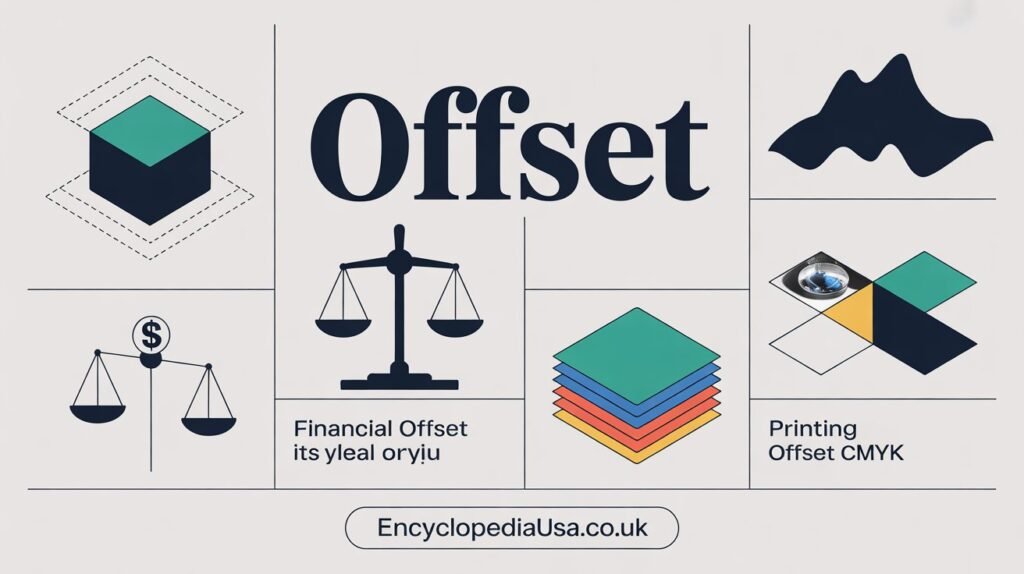
An offset in accounting refers to a transaction or entry that cancels out or reduces the effect of another. It is essentially a counterbalancing move.
Here are a few common financial uses:
Debt offset: When two parties owe each other money, they can offset their debts against each other. Instead of two separate payments, only the net difference changes hands.
Tax offset: In many countries, you can use certain expenses or losses to offset your taxable income. This reduces the total amount of tax you owe.
Profit and loss offset: A business might offset its losses in one area against its gains in another. This is a common practice in investment portfolios.
Hedging as an offset: Investors often buy one asset to offset the risk of another. If one investment drops in value, the offsetting position gains, which limits the overall loss.
The financial use of offset is all about reducing exposure, risk, or obligation through an opposite or equivalent action. If you work in accounting, investing, or business, you will encounter this meaning constantly.
Offset Meaning in Printing
The printing industry gave us one of the most technical but widely used applications of the word: offset printing.
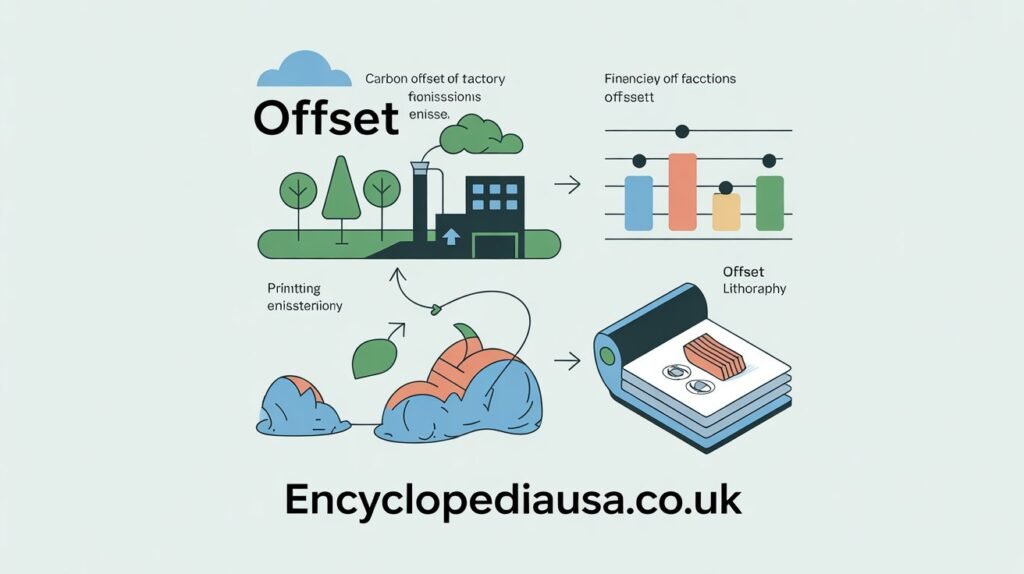
Offset printing, also called offset lithography, is a technique where ink is not applied directly to paper. Instead, the inked image is first transferred to a rubber blanket and then rolled onto the printing surface.
Why is it called “offset”? Because the image is offset from the original plate before it hits the paper. It takes one extra step sideways before it reaches the final surface.
This method produces cleaner, crisper images than direct printing. It is the standard for newspapers, books, magazines, and high-volume commercial printing.
Here is how it works in three basic steps:
- An image is applied to a metal plate using a photographic or digital process.
- The plate transfers the image to a rubber blanket cylinder.
- The rubber blanket presses the image onto paper or another material.
The offset method also allows printing on textured surfaces, since the soft rubber adapts to slight imperfections. That makes it incredibly versatile for large print runs.
Offset Meaning in Environmental Science: Carbon Offsets
If you follow climate news, you have almost certainly heard the phrase “carbon offset.” This is one of the most debated and discussed uses of the word today.
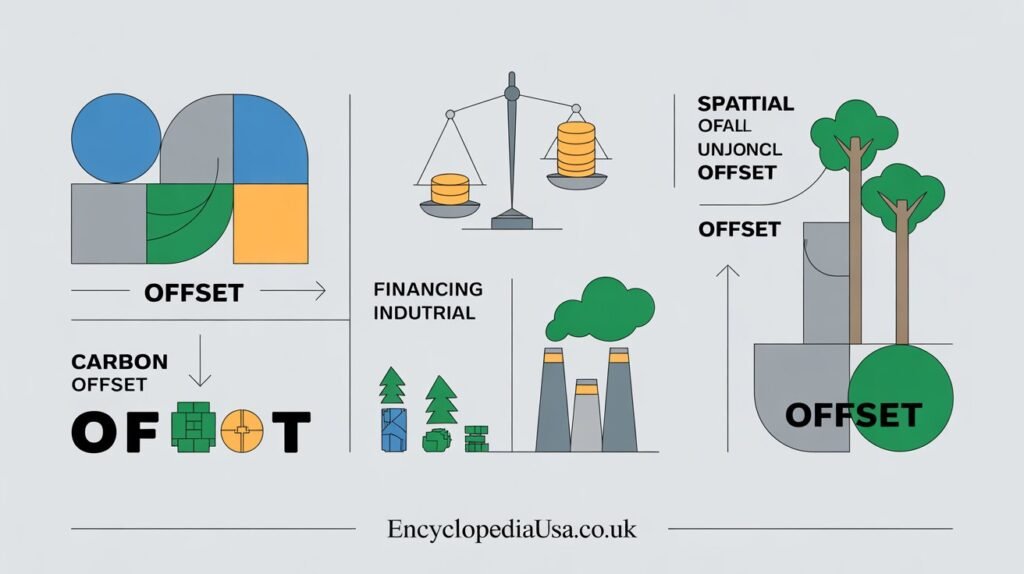
A carbon offset is a way to compensate for greenhouse gas emissions by funding or participating in activities that reduce emissions elsewhere. The idea is to balance out your carbon footprint.
For example:
A company emits 1,000 tons of CO2 through its operations. It cannot immediately eliminate all those emissions. So it pays for the planting of forests or investment in renewable energy projects that will absorb or prevent an equivalent amount of CO2.
The emission happens in one place. The offset happens somewhere else. Together, they theoretically balance to zero.
Carbon offsets come in two main types:
Compliance offsets: These are part of government-regulated systems where companies must offset emissions to meet legal requirements.
Voluntary offsets: These are purchased by individuals and companies who want to reduce their environmental impact beyond what the law requires.
Critics of carbon offsets argue that they allow companies to “buy” their way out of responsibility without making real changes. Supporters argue that offsets provide funding for essential environmental projects that would not otherwise happen.
Understanding this debate starts with understanding what the word offset means at its core: compensation, not elimination.
Offset Meaning in Geography and Surveying
In geography and surveying, offset refers to the perpendicular distance from a main line to a point or feature being measured.
When surveyors map land, they often work from a baseline. To locate a specific point, they measure how far “off” that point sits from the main line. That perpendicular distance is the offset.
This use of offset is about spatial positioning. It answers the question: how far is this feature from my reference line, and in which direction?
Geographers also use the term when describing fault lines. A fault offset refers to the displacement of rock or land on either side of a geological fault. If you have ever seen aerial photos of the San Andreas Fault, the visible shift in roads, fences, or streams is a clear example of geological offset.
Offset Meaning in Engineering and Design
Engineers and product designers use offset frequently to describe physical positioning.
In mechanical engineering, an offset is a distance between two parallel lines or surfaces. For instance, a crankshaft may have an offset to improve balance and rotation efficiency.
In piping systems, an offset is a combination of bends that moves a pipe from one position to a parallel position at a different level or angle. Plumbers and engineers use offset fittings to navigate around obstacles in a building.
In product design, an offset handle or offset tool means the grip is not aligned directly with the working end. This gives better leverage, access, or control. Offset screwdrivers, for example, let you turn screws in tight spaces where a straight screwdriver would not fit.
The engineering meaning always involves a physical gap, displacement, or shift from a baseline position.
Offset Meaning in Music and Audio
Audio engineers and musicians use the word offset in a couple of ways.
DC offset refers to an unwanted shift in the zero baseline of an audio waveform. A healthy audio signal oscillates equally above and below zero. A DC offset means the waveform is pushed off-center, which can cause distortion, clicking sounds, or damage to speakers.
Audio editing software can detect and correct DC offsets automatically. It is a technical but important term in sound production.
In music production, offset also refers to timing. A note or sample that starts slightly before or after the beat is said to have a timing offset. Producers use slight offsets intentionally to create a “feel” or groove in a track.
Offset Meaning in Photography
Photographers use offset in the context of the “rule of thirds” and compositional balance.
An offset composition places the main subject away from the center of the frame. Instead of centering your subject, you shift it to one side. This creates visual tension, balance, and a more dynamic image.
When you apply an offset to your subject, you leave space for negative space or supporting elements. This makes photos feel more natural and interesting compared to perfectly centered shots.
The offset principle in photography is simple: move your focal point away from dead center to create better visual balance.
Everyday Uses of Offset You Might Not Notice
You use the concept of offset more often than you realize in daily life.
When you work extra hours today to make up for leaving early tomorrow, you are offsetting your time.
When a store offers a discount to compensate for a delay, the discount is an offset for the inconvenience.
When you eat a healthy breakfast to balance a heavy dinner the night before, that breakfast is a kind of offset.
The word carries the idea of compensation and balance in almost every context. Once you understand the core meaning, you start seeing it everywhere.
How to Use the Word Offset Correctly
Here are a few practical tips for using offset clearly and correctly.
Use it as a verb when describing an action: “We need to offset these costs.” “She offset the risk by diversifying her investments.”
Use it as a noun when describing a thing: “The insurance payment was an offset against the medical bills.” “A carbon offset can help balance your footprint.”
Use it as an adjective when describing position: “The offset valve is on the left side of the machine.” “They used an offset approach to the printing process.”
Avoid using offset when you just mean “reduce.” Offset implies something specific: a counterbalancing force. To reduce a cost is not the same as to offset it. An offset involves a compensating element on the other side of the equation.
Quick Summary: Offset Meanings at a Glance
Here is a fast reference for the most common meanings of offset:
| Field | What Offset Means |
|---|---|
| General | To balance or compensate for something |
| Finance | A transaction that cancels or reduces another |
| Printing | Ink transferred via rubber before hitting paper |
| Environment | Compensation for emissions through other actions |
| Engineering | A physical displacement from a baseline position |
| Geography | Perpendicular distance from a reference line |
| Audio | A shift in waveform baseline or timing |
| Photography | Placing a subject off-center for visual balance |
Conclusion
The word “offset” is deceptively simple. You can sum up the entire offset meaning in a few words: balance, compensation, or displacement from a reference point.
But as you have seen, those three ideas power an enormous range of applications. From financial accounting to carbon credits, from printing presses to audio waveforms, offset is one of those words that quietly holds entire industries together.
Now that you understand what offset means across different contexts, you can use it with precision. You can follow discussions in finance, climate policy, design, and engineering without losing the thread.
What context do you most often encounter the word offset in? Think about it. You might be surprised how often it shows up once you know what to look for.
Frequently Asked Questions
1. What is the basic meaning of offset? Offset means to balance, counteract, or compensate for something else. It can also refer to a physical displacement from a reference point or baseline.
2. What does offset mean in finance? In finance, an offset is a transaction that reduces or cancels the effect of another transaction. It is commonly used in debt, tax, and investment contexts to achieve net balance.
3. What is a carbon offset? A carbon offset is a compensatory action taken to balance out greenhouse gas emissions. You fund or participate in activities that reduce or absorb an equivalent amount of carbon elsewhere.
4. What does offset mean in printing? Offset printing is a process where ink transfers from a plate to a rubber blanket, then to paper. The image is “offset” from the original plate before reaching the final surface.
5. What is the difference between offset and reduce? To reduce means to make something smaller. To offset means to compensate for something with a balancing force. An offset does not remove the original thing; it creates an equal and opposite effect.
6. Can offset be used as both a noun and a verb? Yes. As a noun, it refers to the compensating thing itself. As a verb, it describes the act of compensating or balancing. “The refund was an offset” (noun). “The refund offset the overpayment” (verb).
7. What is a DC offset in audio? A DC offset is a shift in the center baseline of an audio signal. Instead of oscillating equally above and below zero, the waveform tilts to one side. This can cause distortion and is usually corrected in post-production.
8. What does offset mean in photography? In photography, an offset composition means placing the main subject away from the center of the frame. This creates a more visually dynamic and balanced image.
9. What is fault offset in geology? A fault offset refers to the displacement of rock or terrain on either side of a geological fault line. It measures how far one side has shifted relative to the other.
10. Is offset the same as cancel? Not exactly. To cancel means to eliminate or void something entirely. To offset means to counterbalance it with something equivalent. The original thing still happened; the offset just creates an equal counterweight.
Read More : Connections Hint Today Mashable
Author Bio: Sara Malik is a content writer and language specialist with over eight years of experience creating SEO-optimized, reader-first content across finance, technology, and education. She has a passion for making complex concepts easy to understand for everyday readers. When she is not writing, she spends her time reading linguistic research and exploring new ways to make words work harder.