
Preschool at Home Curriculum Free: Easy Wins, Less Stress in 2026
Introduction
Do you want to teach your preschooler at home without spending a lot on curriculum? You can create a rich learning routine with books, household items, outdoor play, conversations, and carefully chosen free resources. A preschool at home curriculum free plan can help you save money while giving your child meaningful learning experiences.
The secret is not finding hundreds of worksheets. It is creating a simple routine that supports the skills your child needs while leaving plenty of time for play and discovery.
In this guide, you will learn what a good free preschool curriculum should include, how to create a weekly plan, which trusted educational organizations can help, and how to turn ordinary home activities into learning opportunities.
You will also find research based advice, useful statistics, expert guidance, practical tables, and answers to common questions.
Most importantly, you will see how a preschool at home curriculum free approach can become simple enough to use every day without making your home feel like a traditional classroom.
What Is a Preschool at Home Curriculum?
A preschool at home curriculum is a planned collection of activities and learning goals designed for young children who learn primarily at home.
A free version may include lesson ideas, learning sequences, printable activities, digital resources, books, games, or developmental guidelines that do not require you to purchase a complete commercial program.
However, free resources vary greatly.
Some provide a complete learning framework. Others only provide individual activities.
A strong preschool plan should support several areas of development.
| Learning Area | Skills Your Child Can Practice |
|---|---|
| Language | Speaking, listening, vocabulary |
| Early Literacy | Letters, sounds, stories, writing |
| Mathematics | Counting, shapes, patterns |
| Science | Observation, exploration, prediction |
| Social Emotional Skills | Feelings, sharing, cooperation |
| Physical Development | Balance, movement, coordination |
| Creativity | Art, music, imagination |
| Life Skills | Independence, routines, problem solving |
This whole child approach is consistent with guidance from the National Association for the Education of Young Children, commonly known as NAEYC. Its developmentally appropriate practice guidance emphasizes learning across developmental areas rather than focusing narrowly on academic skills.
Can You Really Homeschool Preschool for Free?
Yes.
You can create a useful preschool learning routine without purchasing an expensive curriculum package.
You can use books from your local library, household objects for mathematics, nature for science, music for movement, and everyday conversations for language development.
You can also use established educational resources that provide free learning materials.
The important point is this:
Free does not automatically mean complete, and expensive does not automatically mean better.
Evaluate every resource based on its quality, developmental appropriateness, learning goals, and flexibility.
What Should a Free Preschool Curriculum Teach?
A good curriculum should provide a balanced experience.
Language and Literacy
Read together every day.
Ask your child questions about the story.
Introduce new vocabulary.
Play rhyming games.
Look for letters in books and around your home.
Encourage your child to draw and experiment with writing.
Mathematics
Count toys.
Sort household objects.
Compare big and small items.
Create patterns.
Identify shapes.
Use cooking activities to introduce simple measurement.
Science
Observe plants.
Watch insects.
Explore water.
Talk about weather.
Collect leaves.
Ask questions about what your child sees.
Social Emotional Learning
Talk about feelings.
Practice taking turns.
Use pretend play to explore social situations.
Encourage your child to solve small problems independently.
Physical Development
Walk.
Jump.
Dance.
Climb safely.
Play ball.
Use play dough.
Draw with crayons.
These activities develop both large and small muscle skills.
Which Free Resources Can Help With Preschool at Home?
Several established organizations can support your planning.
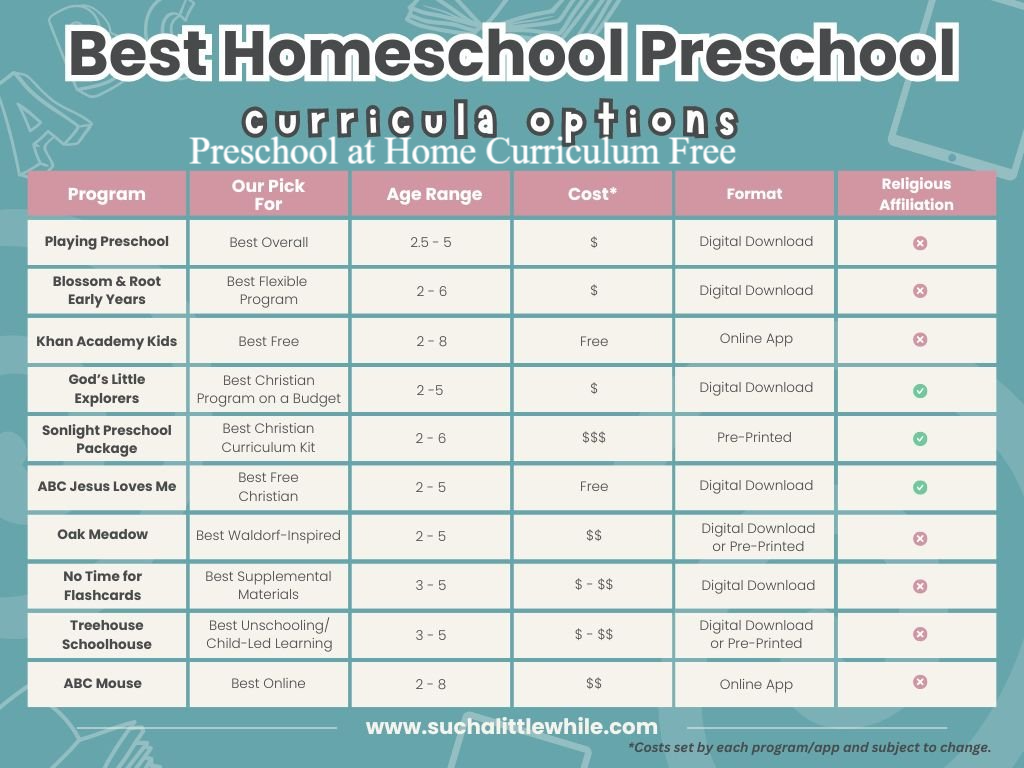
Khan Academy Kids
Khan Academy Kids provides a free learning program for children ages two through eight.
Its current program includes early literacy, reading, writing, language, mathematics, books, creative activities, and social emotional learning.
Khan Academy Kids states that the program is 100 percent free and does not use advertisements or subscriptions. The organization also says its curriculum was created with learning experts and aligns with the Head Start Early Learning Outcomes Framework.
This makes it useful as one part of a home preschool routine.
It should not replace reading together, physical play, conversation, creative activities, and real world exploration.
Core Knowledge
Core Knowledge provides a Preschool Sequence designed for children ages three through five.
Its framework addresses physical, social, linguistic, and cognitive development.
This type of resource can help you understand what children can explore at different stages.
It is especially helpful if you prefer a structured approach.
Head Start
Head Start provides the Early Learning Outcomes Framework.
You can use it as a planning reference.
Instead of asking whether you have completed enough worksheets, you can ask whether your child is developing across different areas.
Consider these questions:
- Are we developing language?
- Are we practicing early literacy?
- Are we exploring mathematics?
- Are we encouraging curiosity?
- Are we developing social skills?
- Are we supporting physical development?
- Are we building independence?
This gives your home preschool a much broader foundation.
Why Is Play So Important?
Play is not a break from learning.
For preschool children, play is one of the most powerful ways to learn.
NAEYC describes play as a central teaching practice that supports language, social development, cognitive skills, self regulation, physical development, and problem solving. Its guidance also recommends daily opportunities for both indoor and outdoor play.
This means you can teach without making every activity look like school.
Build a tower and talk about shapes.
Play restaurant and practice counting.
Pretend to run a store and discuss numbers.
Use toy animals to create stories.
Play outside and talk about nature.
The learning happens naturally.
How Do You Create a Free Preschool Schedule at Home?
You do not need a strict timetable.
Preschool children often learn better when you provide short activities and frequent opportunities for movement.
Here is a simple example.
| Part of Day | Learning Activity |
|---|---|
| Morning | Story and conversation |
| Early Morning | Letter or sound activity |
| Mid Morning | Counting or sorting |
| Before Lunch | Outdoor exploration |
| Afternoon | Art or building |
| Later Afternoon | Music and movement |
| Evening | Reading and conversation |
You can change the routine based on your family’s needs.
The schedule should create consistency without creating pressure.
What Does a Free Weekly Preschool Curriculum Look Like?
Choose one theme each week.
For example, choose The Ocean.
| Day | Literacy | Mathematics | Science | Creative Activity |
|---|---|---|---|---|
| Monday | Ocean story | Count fish | Ocean animals | Fish drawing |
| Tuesday | New vocabulary | Sort shells | Animal habitats | Paper fish |
| Wednesday | Letter practice | Compare sizes | Water exploration | Ocean painting |
| Thursday | Story retelling | Create patterns | Sea animals | Pretend play |
| Friday | Review words | Counting game | Nature discussion | Ocean collage |
You can repeat this structure with many themes.
Try:
- Animals
- Plants
- Weather
- Space
- Transportation
- Dinosaurs
- Colors
- Community helpers
- Families
- Seasons
One theme can support several subjects.
That makes planning much easier.
How Can Everyday Activities Become Preschool Lessons?
You do not need special equipment.
Your home already contains useful learning materials.
Cooking
Count ingredients.
Compare quantities.
Talk about hot and cold.
Follow a simple sequence.
Laundry
Match socks.
Sort colors.
Count clothing items.
Compare sizes.
Gardening
Plant seeds.
Observe changes.
Measure growth.
Talk about sunlight and water.
Grocery Shopping
Identify colors.
Count items.
Compare quantities.
Look for familiar letters.
Cleaning
Sort objects.
Follow directions.
Organize items.
Practice independence.
These simple activities can become valuable parts of a preschool at home curriculum free plan.
What Do Experts Say About Preschool Curriculum?
NAEYC recommends developmentally appropriate practice based on children’s development, individual characteristics, and learning context.
Its curriculum guidance emphasizes meaningful learning goals, play, flexibility, and activities that respond to children’s interests and experiences. It also cautions against rigid, highly scripted curriculum that does not allow teachers to adapt learning experiences.
This advice works well for home education.
Suppose your child loves animals.
Use animals to teach counting, vocabulary, science, storytelling, art, and movement.
If your child loves vehicles, use cars and trucks to explore speed, size, shapes, colors, counting, and pretend play.
Your child’s interests can become the foundation of your curriculum.
How Much Academic Work Does a Preschooler Need?
There is no single schedule that works for every child.
Preschoolers have different attention spans, interests, developmental needs, and energy levels.
Instead of planning long academic sessions, use short learning experiences throughout the day.
A useful home routine might include:
- One or two story sessions
- A short mathematics activity
- A language activity
- Outdoor play
- Creative work
- Free play
- Practical life activities
You should also allow your child to explore independently.
A child who spends ten minutes building with blocks may be developing spatial reasoning, persistence, language, and problem solving without realizing it.
Should You Use Worksheets?
Worksheets can have a place in preschool, but they should not become the center of your curriculum.
Children need active learning experiences.
Balance paper activities with:
- Books
- Blocks
- Puzzles
- Play dough
- Painting
- Music
- Outdoor play
- Cooking
- Nature walks
- Pretend play
If your child becomes frustrated with worksheets, try teaching the same skill through play.
For example, instead of tracing numbers, count toy cars.
Instead of completing a letter worksheet, find the same letter on food packages.
Learning does not have to look like schoolwork.
Our Research Based Quality Checklist
After reviewing current guidance from NAEYC and established early learning resources, several qualities stand out.
| Quality | Why It Matters |
|---|---|
| Clear goals | Gives your teaching direction |
| Play based learning | Matches how young children learn |
| Multiple subjects | Supports whole child development |
| Flexibility | Lets you follow your child’s needs |
| Conversation | Builds language skills |
| Hands on activities | Encourages active learning |
| Observation | Helps you notice progress |
| Age appropriate content | Reduces frustration |
The evidence suggests that a high quality curriculum should not force every child through the same rigid sequence.
Instead, you should use goals as a guide and adapt activities to your child.
What Mistakes Should Parents Avoid?
A free curriculum can become stressful when you collect too many resources.
Avoid these common mistakes:
- Downloading everything you find
- Changing programs every week
- Focusing only on letters and numbers
- Expecting long periods of sitting
- Comparing your child with other children
- Treating preschool like elementary school
- Ignoring outdoor play
- Forgetting social emotional development
- Turning every activity into a test
Keep your system simple.
One structured resource, good books, household materials, and plenty of play can provide a strong foundation.
Can You Build a Complete Preschool Curriculum Without Buying One?
Yes, with thoughtful planning.
You can combine:
Learning goals
Use established early childhood frameworks.
Activities
Create simple experiences around weekly themes.
Books
Use your local library and books you already own.
Digital resources
Use reputable free educational programs in moderation.
Everyday learning
Turn cooking, cleaning, gardening, and outdoor exploration into learning opportunities.
Observation
Watch what your child understands and what they still need to practice.
This combination can create a practical preschool at home curriculum free plan that feels personalized rather than generic.
Conclusion
A preschool at home curriculum free approach can give your child a meaningful learning foundation without requiring an expensive curriculum package.
The most important thing is balance.
Teach language and early literacy.
Explore mathematics.
Discover science.
Create art.
Move every day.
Read often.
Play freely.
Talk about your child’s ideas.
Trusted organizations such as NAEYC, Head Start, Core Knowledge, and Khan Academy Kids can help you understand developmentally appropriate learning and provide useful resources. NAEYC’s current guidance especially reinforces the importance of play, exploration, inquiry, and flexible curriculum planning.
You do not need to recreate a traditional classroom at home.
Start with one theme.
Choose a few activities.
Use what you already have.
Follow your child’s interests.
Most importantly, enjoy the time you spend learning together.
What topic would your preschooler be excited to explore this week?
Frequently Asked Questions
What is a preschool at home curriculum free program?
It is a collection of free learning goals, activities, resources, and teaching ideas that parents can use to provide preschool education at home.
Can I homeschool preschool without buying a curriculum?
Yes. You can combine books, free educational resources, household activities, outdoor exploration, play, and simple lesson plans.
What should a preschool curriculum include?
A balanced curriculum should include language, early literacy, mathematics, science, social emotional development, physical development, creativity, and practical skills.
Is Khan Academy Kids free?
Yes. Khan Academy Kids currently states that its program is 100 percent free, with no advertisements or subscriptions.
What age is Khan Academy Kids designed for?
Khan Academy Kids is designed for children ages two through eight. It can therefore support preschool learning as well as some early elementary learning.
How long should preschool lessons be?
There is no universal lesson length. Short activities combined with movement, play, conversation, and exploration often fit preschool children’s needs better than long formal lessons.
Do preschool children need worksheets?
No. Worksheets can support selected skills, but preschool children also need play, movement, books, conversation, creativity, and hands on learning.
How can I teach preschool math at home?
Use counting games, sorting, patterns, shapes, cooking, building, measuring, and everyday activities.
How can I teach reading to my preschooler?
Read together every day, discuss stories, introduce vocabulary, play sound games, explore letters, and encourage drawing and early writing.
What is the most important part of home preschool?
A balanced and responsive learning environment matters most. Follow your child’s interests while providing opportunities across different developmental areas.
FAQ Schema Content
Question: What is a preschool at home curriculum free program?
Answer: It is a collection of free learning goals, activities, resources, and teaching ideas that parents can use to provide preschool education at home.
Question: Can I homeschool preschool without buying a curriculum?
Answer: Yes. Parents can combine books, free educational resources, household activities, outdoor exploration, play, and simple lesson plans.
Question: What should a preschool curriculum include?
Answer: A balanced curriculum should include language, early literacy, mathematics, science, social emotional development, physical development, creativity, and practical skills.
Question: Is Khan Academy Kids free?
Answer: Yes. Khan Academy Kids currently states that its program is 100 percent free, with no advertisements or subscriptions.
Question: What age is Khan Academy Kids designed for?
Answer: Khan Academy Kids is designed for children ages two through eight and can support preschool and early elementary learning.
Question: Do preschool children need worksheets?
Answer: No. Worksheets can support selected skills, but preschool children also need play, movement, books, conversation, creativity, and hands on learning.
Question: How can I teach preschool math at home?
Answer: Use counting games, sorting, patterns, shapes, cooking, building, measuring, and everyday activities.
Question: How can I teach reading to my preschooler?
Answer: Read together every day, discuss stories, introduce vocabulary, play sound games, explore letters, and encourage drawing and early writing.
Author Bio
About the Author
The author creates practical educational content for parents, homeschool families, and early childhood educators. Their work focuses on affordable learning, preschool development, homeschooling strategies, and simple activities that make education engaging and accessible.n
Homeschool Preschool Curriculum Free