
Homeschool Preschool Curriculum Free: Brilliant Help in 2026
Introduction
Do you want to homeschool your preschooler without spending hundreds of dollars on curriculum? You can. A homeschool preschool curriculum free approach can give your child meaningful learning experiences while keeping your family budget under control.
Preschool homeschooling does not require a large classroom, expensive workbooks, or a strict school schedule. Your child can learn through stories, conversations, games, outdoor exploration, art, music, building, cooking, and simple number activities.
The challenge is knowing what to teach and which free resources are worth your time.
This guide shows you how to create a homeschool preschool curriculum free plan that is practical, flexible, and developmentally appropriate. You will discover trusted resources from organizations such as Core Knowledge, Head Start, NAEYC, and Khan Academy Kids. You will also find research findings, a simple weekly schedule, activity ideas, and answers to common questions.
The goal is not to make preschool feel like elementary school. The goal is to help your child build strong foundations while enjoying the process.
What Is a Homeschool Preschool Curriculum Free Program?
A homeschool preschool curriculum free program is a collection of learning goals, activities, lesson ideas, books, digital resources, and teaching materials that you can use without purchasing a commercial preschool curriculum.
Some free resources offer complete learning sequences.
Others provide individual activities or digital lessons.
You can combine several trustworthy resources to create a personalized program.
A balanced preschool plan should cover these areas:
| Learning Area | Skills to Practice |
|---|---|
| Language | Vocabulary, listening, speaking |
| Literacy | Letters, sounds, stories, early writing |
| Mathematics | Counting, shapes, patterns, comparison |
| Science | Observation, exploration, prediction |
| Social Emotional Skills | Feelings, sharing, cooperation |
| Physical Skills | Balance, coordination, movement |
| Creativity | Art, music, imagination |
| Practical Skills | Independence, routines, problem solving |
This broad approach helps you avoid focusing only on letters and numbers.
Is Free Preschool Homeschool Curriculum Effective?
Yes, but quality matters more than price.
The National Association for the Education of Young Children, known as NAEYC, recommends developmentally appropriate learning that responds to children’s interests, experiences, strengths, languages, and individual needs.
NAEYC also identifies play as a central part of early childhood curriculum.
That matters because preschool children learn through active experiences.
A child can develop mathematical thinking while building with blocks.
A child can develop vocabulary while talking about a picture book.
A child can develop science skills while observing insects outside.
A child can practice social skills while playing a game with a sibling.
The curriculum gives you direction. Your interactions make the learning meaningful.
sourecs ; theschoolhouse.org
Why Are More Families Looking for Affordable Preschool Options?
Cost is one reason.
Early childhood education can represent a significant expense for families. According to the National Center for Education Statistics, 47 percent of children ages three and four were enrolled in school in 2022. That represented an increase from 40 percent in 2021.
More recent data from the National Institute for Early Education Research reported that state funded preschool programs served almost 1.8 million children during the 2024 to 2025 school year.
These figures show how many families rely on some form of early learning.
A free homeschool approach can give families another option for providing structured learning experiences at home.
However, homeschooling requirements differ by location. Always check the rules that apply to your family.
What Should a Free Preschool Homeschool Curriculum Include?
You do not need hundreds of lessons.
You need consistency and variety.
A useful program should include:
- Daily reading
- Language rich conversations
- Early mathematics
- Letter and sound exploration
- Science discovery
- Outdoor movement
- Creative activities
- Pretend play
- Fine motor practice
- Social emotional learning
You can also add practical life activities.
Cooking, cleaning, gardening, sorting laundry, and organizing toys can all create learning opportunities.
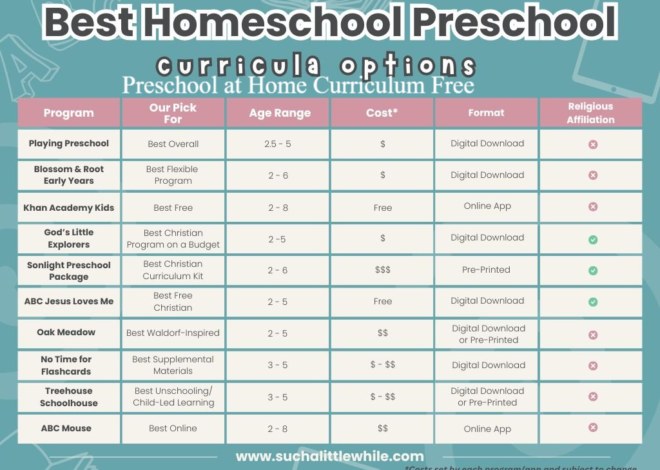
Which Free Preschool Homeschool Resources Are Best?
Several established organizations can support your planning.
Khan Academy Kids
Khan Academy Kids offers a free educational program for children ages two through eight.
The program includes early literacy, reading, writing, language, mathematics, books, creative activities, and social emotional learning.
The organization currently states that its mobile program is 100 percent free, with no advertisements or subscriptions. It also says the curriculum was created with learning experts at Stanford and aligns with the Head Start Early Learning Outcomes Framework.
Khan Academy Kids reports a peer reviewed study conducted with researchers from the University of Massachusetts Amherst. The organization says preschool children from low income families using the program moved from the 34th percentile to the 47th percentile in pre literacy skills after ten weeks.
That finding is encouraging, but you should not treat an educational app as a complete replacement for adult interaction, play, reading, and real world experiences.
Core Knowledge
Core Knowledge provides a Preschool Sequence for children ages three through five.
The sequence covers physical, social, linguistic, and cognitive development.
It provides clearly stated learning goals and skills and encourages adults to use assessment and observation when planning activities.
This makes Core Knowledge useful when you want more structure in your homeschool.
Head Start
Head Start provides the Early Learning Outcomes Framework.
You can use it as a planning guide rather than treating it as a daily curriculum.
It helps you think about areas such as:
- Language and literacy
- Social and emotional development
- Cognition
- Physical development
- Approaches to learning
It is especially useful when you want to check whether your curriculum supports the whole child.
How Do You Create Your Own Free Preschool Curriculum?
Start with a theme.
Choose something your child already loves.
For example, choose Animals.
Then connect the theme to several learning areas.
Language Activity
Read an animal story.
Ask your child to name the animals.
Introduce new words such as habitat, fur, feather, nest, and wild.
Mathematics Activity
Count toy animals.
Sort them by size.
Create simple patterns.
Compare which group has more animals.
Science Activity
Discuss what animals eat.
Talk about animal homes.
Observe birds or insects outside.
Creative Activity
Draw an animal.
Make an animal mask.
Pretend to move like different animals.
This method lets one theme support several subjects.
What Does a Free Weekly Preschool Schedule Look Like?
Your schedule should remain flexible.
Preschool children do not need long academic sessions.
Here is a simple example:
| Day | Literacy | Math | Science | Creative Learning |
|---|---|---|---|---|
| Monday | Animal story | Count animals | Animal needs | Animal drawing |
| Tuesday | Letter practice | Sort animals | Animal homes | Animal craft |
| Wednesday | New vocabulary | Compare sizes | Animal bodies | Movement game |
| Thursday | Story retelling | Make patterns | Animal food | Animal painting |
| Friday | Review words | Counting game | Nature walk | Pretend play |
You can use the same structure for different themes.
Try themes such as:
- Plants
- Weather
- Space
- Transportation
- Ocean life
- Dinosaurs
- Community helpers
- Colors
- Seasons
- Families
How Much Time Should Preschool Homeschool Take?
There is no universal schedule.
Your child’s age, personality, attention span, and interests all matter.
Instead of planning several hours of formal lessons, create short learning opportunities throughout the day.
For example:
Morning
Read a story and talk about it.
Mid morning
Practice numbers or letters.
Before lunch
Go outside and explore.
Afternoon
Create art or build with blocks.
Evening
Read another book and discuss the day.
This approach keeps learning manageable.
It also allows your child to move and play.
Can Everyday Activities Become Preschool Lessons?
Absolutely.
This is one of the biggest advantages of homeschooling.
Cooking
Practice counting ingredients.
Compare quantities.
Talk about measurements.
Grocery Shopping
Find colors.
Count items.
Compare prices when appropriate.
Identify letters on packages.
Gardening
Plant seeds.
Observe growth.
Measure plants.
Discuss weather.
Cleaning
Sort objects.
Match pairs.
Count items.
Practice following directions.
These activities make learning practical.
Should a Free Preschool Curriculum Include Worksheets?
Worksheets can help with specific skills, but they should not dominate your preschool day.
Young children need opportunities to move, explore, talk, create, and play.
Try balancing worksheets with:
- Picture books
- Puzzles
- Blocks
- Play dough
- Painting
- Music
- Outdoor exploration
- Pretend play
- Cooking
- Nature walks
If your child dislikes worksheets, you do not need to force them into every activity.
Find another way to practice the same skill.
What Do Early Childhood Experts Recommend?
NAEYC recommends curriculum that builds meaningful goals while remaining responsive to each child.
Its guidance says educators should use information from observation and assessment to adapt learning experiences.
That principle works beautifully for homeschooling.
Suppose your child already recognizes most letters.
You can spend less time reviewing them and more time developing letter sounds, vocabulary, storytelling, or early writing.
Suppose your child loves numbers.
Use that interest to introduce counting games, patterns, shapes, and simple measurement.
Your child’s interests can become your teaching advantage.
Our Research Based Quality Checklist
We compared common principles across major early childhood organizations and established education providers.
The same qualities appeared repeatedly.
A strong preschool program should offer:
| Quality | Why It Matters |
|---|---|
| Clear goals | Gives learning direction |
| Age appropriate content | Reduces frustration |
| Play | Supports natural learning |
| Conversation | Builds language |
| Hands on activities | Encourages active participation |
| Multiple subjects | Supports whole child development |
| Flexibility | Allows personalization |
| Observation | Helps you notice progress |
This suggests an important rule.
Do not choose a curriculum because it has the most pages. Choose it because it helps your child learn.
What Mistakes Should You Avoid?
Free resources are useful, but too many choices can create stress.
Avoid these common mistakes:
- Downloading more materials than you can use
- Changing your curriculum every week
- Focusing only on reading and mathematics
- Expecting your child to sit for long periods
- Comparing your child with other children
- Turning every activity into a test
- Ignoring outdoor play
- Forgetting social emotional development
- Making homeschooling too rigid
Keep your system simple.
One structured resource, a few books, household materials, and plenty of play can go a long way.
Is a Free Homeschool Preschool Curriculum Enough?
For many families, free resources can provide a strong foundation when combined thoughtfully.
However, no single free resource needs to do everything.
You can use Core Knowledge for structure.
You can use Khan Academy Kids for interactive practice.
You can use Head Start guidance to review developmental areas.
You can use books, nature, household activities, music, art, and play to fill out the experience.
This combination can create a practical homeschool preschool curriculum free plan without requiring a large budget.
Conclusion
A homeschool preschool curriculum free approach can help you give your child meaningful early learning while keeping costs low.
You do not need an expensive curriculum package.
You need clear goals, age appropriate activities, books, conversations, play, movement, creativity, and consistency.
Organizations such as Core Knowledge, Head Start, NAEYC, and Khan Academy Kids provide useful examples and resources that can guide your planning.
Start with one weekly theme.
Choose a few simple activities.
Read together every day.
Explore outside.
Let your child ask questions.
Follow their interests.
The best homeschool preschool curriculum free plan is not the one with the most worksheets. It is the one that fits your child and helps them stay curious about learning.
What topic would your preschooler be excited to explore this week?
Frequently Asked Questions
What is a homeschool preschool curriculum free program?
It is a collection of free learning goals, activities, teaching resources, and educational materials that parents can use to homeschool preschool children.
Is free preschool curriculum good for homeschooling?
Yes. Free resources can work well when you combine them with books, play, conversation, outdoor activities, and hands on learning.
What subjects should preschool homeschool include?
A balanced program should include language, literacy, mathematics, science, social emotional development, physical development, creativity, and practical skills.
Is Khan Academy Kids free?
Yes. Khan Academy Kids currently states that its mobile program is 100 percent free, with no advertisements or subscriptions.
What age is Khan Academy Kids for?
Khan Academy Kids is designed for children ages two through eight.
Is Core Knowledge Preschool free?
Yes. The Core Knowledge Preschool Sequence is freely available for noncommercial use and is designed for children ages three through five.
Can I create my own preschool curriculum?
Yes. You can choose weekly themes and connect them to reading, mathematics, science, art, movement, language, and practical activities.
How many hours should I homeschool my preschooler?
There is no universal number. Short learning activities throughout the day can work well because preschool children benefit from movement, play, and varied experiences.
Do preschool homeschoolers need worksheets?
No. Worksheets can support particular skills, but preschool children also need play, conversation, exploration, movement, creativity, and hands on learning.
How do I know if a free preschool curriculum is good?
Look for clear learning goals, age appropriate activities, multiple developmental areas, flexibility, play based learning, hands on experiences, and opportunities for adult interaction.
FAQ Schema Content
Question: What is a homeschool preschool curriculum free program?
Answer: It is a collection of free learning goals, activities, teaching resources, and educational materials that parents can use to homeschool preschool children.
Question: Is free preschool curriculum good for homeschooling?
Answer: Yes. Free resources can work well when combined with books, play, conversation, outdoor activities, and hands on learning.
Question: What subjects should preschool homeschool include?
Answer: A balanced program should include language, literacy, mathematics, science, social emotional development, physical development, creativity, and practical skills.
Question: Is Khan Academy Kids free?
Answer: Yes. Khan Academy Kids currently states that its mobile program is 100 percent free, with no advertisements or subscriptions.
Question: Can I create my own preschool curriculum?
Answer: Yes. You can choose weekly themes and connect them to reading, mathematics, science, art, movement, language, and practical activities.
Question: Do preschool homeschoolers need worksheets?
Answer: No. Worksheets can support particular skills, but preschool children also need play, conversation, exploration, movement, creativity, and hands on learning.
Author Bio
About the Author
The author creates practical educational content for parents, homeschool families, and early childhood educators. Their work focuses on affordable learning, child development, homeschooling strategies, and simple activities that make education engaging and accessible.